http://www.fisheaglepoint.com/
Wednesday June 22nd:
We had hoped to take a dhow, the traditional wooden sailboat, from Tanga to Fish Eagle Point (FEP), but the weather did not cooperate. Simon from FEP picked us up at the hotel instead. We drove along the very good road, built by America as an aid project, until turning offonto a dirt road. We drove along tons of coconut palms and occasional baobab trees. The road grew rutted and muddy. We passed a large village with a fine American built school. The tribe in these parts are the Digo. Most of the homes had thatched roofs unlike the metal roofs of the mountain homes which were often constructed from repurposed vegetable oil cans.
We traveled further to a remote area. We parked amidst some mangroves and followed Simon to our AMAZING cottage on the beach.
CLICK PHOTOS TO SEE LARGER VERSION


Our cottage is artistically designed and open with half walls, and a soaring thatched roof. We have a porch, main bedroom, second bedroom, large bathroom and storage room. The cottage is on the beach and at high tide the water is within feet.
The tide was a long way out revealing the sea floor, a huge beautiful piece of white driftwood, and an undercut tower of rock with mangroves on top that is an island at high tide.


The girls began beach combing immediately. Reef shoes are a must as sea urchins are lurking in crevices. Fish Eagle Point does not allow any shell collecting and as a consequence the beach is covered in the most amazing variety of shells including scores of intact sea urchins. Joe and I took the long path through the mangroves, past other cottages, to the extensive main lodge, pool and kitchen. After getting some reef shoes and bananas. We rejoined the girls on the beach before our cottage. They were walking with Benjamin and two german shepards. Benjamin is the dog’s trainer and the young dogs are working on socialization with the tourists, and kids in particular.


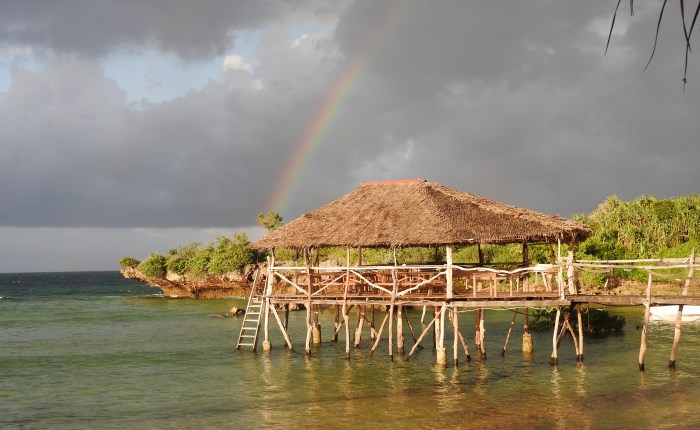
Our lunch was served on a pier off the main lodge, built over the beach area that was dry at low tide.


We chatted with Simon, a white man raised in Zimbabwe, South Africa and Tanzania, and his girlfriend Eva, from Latvia. The beach area off the main lodge is a crescent shape edged by undercut coral rock mangrove topped towers that become islands at high tide. As we ate, we watched the tide come in quickly filling the beach area basin. The girls climbed down the ladder from the pier and explored the craggy rocks. Soon the girls were wading and then swimming as the tide came in.


We spent the afternoon at the main lodge. Beach combing, swimming in the ever deeper water, and the girls enjoyed the pool. Shortly after 5 PM, at high tide, we went out on kayaks with Eva into the mangroves. The water in the mangroves was clear and we snorkeled. Unfortunately the coral reef in the mangroves had a fair amount of bleaching damage. We did see some healthy corals and two huge clams. These clams were at least 18 inches across with a wavy lip that faced up right. Between the clam shells was a vibrant purple flesh that quivered and retracted if you swam close.
It was pretty late by the time we got back. We cleaned up, eat dinner and went to bed. It was hot and the breeze from the open walls was welcome. We could hear the ocean close by all night.
Thursday June 23nd:
There is a long trail between our room and the main lodge. There are always hermit crabs and large millipedes scuttling along the path. At night, bats flutter by.
We hung around the lodge in the morning as the tide went out.


Mid morning, when the tide was low, we donned our snorkel gear and awkwardly made our way through the sea urchin infested shallows to deeper water where we snorkled around individual coral “bomas”. Unfortunately here too there was extensive coral bleaching and the reef did not look healthy. Still we saw some nice corals and fish. I saw more anemone than I have ever seen, but they were ominously snow white instead of the expected creamy orange color. Again I saw some of the amazing giant clams. After the others made their way in, I swam out to the farther reef and found it to be in the same condition.
Another family arrived in the afternoon, Mikale is Danish and had lived in Tanga for five years, and her Tanga native husband of Indian descent Darmesh, and their two young children. The family are old friends of Simon.
After a lazy afternoon we had a fine dinner including fresh calamari.


Friday June 24th:
We were up early, before the basket with tea, instant coffee and little pieces of cake arrived on our porch. After spending some time on our beach we headed to the lodge for breakfast. After breakfast I want on a village tour with Aidi while Joe and the girls stayed around FEP.
Aidi speaks no English and I only know greetings and a few words in Swahili, so we had interesting communications all morning! We walked along fields passing a few baobab trees. Then we entered a coconut tree grove with occasional mango trees and areas of banana trees. We passed a few villagers who were delighted with my fumbling greetings in Swahili. Aidi kept coaching me and tried to teach me too many Swahili words until my brain was overflowing. Aidi toured me around three villages and I greeted the people over and over again and was very well received. I saw a couple of their open wells with coral rag (stone) walls and cut open plastic cans tied to ropes to haul the water out. According to Simon of FEP, the water is brackish and would be deemed non potable by us, but the Digo tribe live their whole lives drinking it. The largest of the three villages seemed to be growing fast with lots of new construction including a new mosque. Many colorfully dressed women were engaged in washing clothes in in sudsy tubs, while others were grouped together on a front porch plaiting palm fronds to make long narrow runners. When asked, the grown ups refused to have their picture taken. The throng of kids that gathered behind me hand no such qualms. The men not engaged in construction endeavors seemed to be just hanging out.


After lunch we joined Aidia again for a hike around the rock tidal pools along the shore. We had a late start and the tide was coming in fast. We walked up to our knees in water, under the undercut coral rage bluffs. The wind howled making it impossible to hear each other speak, but keeping it cool as well. We kept a brisk pace trying to keep up with Aidi as we raced against the tide. Eventually we turned inland across a shallow submerged bay with tons of brittle sea stars, a few sea cucumbers and lots of seaweed and onto a beach.


On the beach we found a fisherman. We showed us the many squid he’d caught. He also subtly relinquished the beautiful huge puka shell he’d collected against the rules of FEP. Coming up from the beach we encountered a spectacular baobab and then followed an overgrown footpath to a dirt road leading back to FEP.
Back at the lodge we met the latest guests Erna and Mark, a California couple originally from Texas. Erna runs a nonprofit focused on rural education in Tanzania and Kenya. For dinner we had an amazing feast on huge delicious crabs caught in the mud of the neighboring mangroves.
Saturday, June 25th:
After breakfast all the guests wade through the high tide and boarded the dhow, an ancient Arabian style of sail boat. It was very overcast, but we motored out of the bay hoping the sun would break through. The winds this time of year blow in one direction, so the plan was to motor to a sandbar that is exposed at low tide, and sail back. We motored into the wind and the boat heaved up and down smacking into the grey waves sending water spraying over the bow where the girls were seated delighted. After an hour we arrived at the sandbar before it was exposed and I was feeling pretty seasick despite the Dramamine. We threw anchor and tossed in the boat or swam in the shallow water awaiting the tide to drop. The sky was a heavy grey and and the wind was relentless and brisk. I took another Dramamine. We’d all brought snorkel gear, but it mostly went unused in the choppy water under the dark sky.


Finally, the sandbar began to appear and I sat on the much appreciated stable ground shivering, but starting to feel better. Flocks of terns and a lone kite or eagle circled the sandbar annoyed by our presence. The sandbar was littered with shells and coral bits. After a bit those of us on the sandbar returned to the dhow. The crew pulled in the anchor, hoisted the sail, and secured ropes. The Dramamine was working, the sea was calmer and we enjoyed the rapid sailing back to FEP. We anchored way out because the tide was low and waded in across the seagrass.


We all enjoyed lunch on the pier and afterwards Eva led me and the girls on a short walk through the mangroves and then retracing some of our previous days rock pool hike. Eva showed us amazing fossilized giant clams tucked back in the caves within the craggy rocks.


The remainder of the afternoon was spent napping, reading, writing and showering.
 Family Adventures