
Sunday, July 24th:
In the morning we enjoyed a final game drive in beautiful Tarangire national park before exiting into the adjacent Maasai pasture lands and villages. Along the road we saw Maasai boys dramatically dressed in black with white geometric face painting signifying their recent circumcision and new status as warriors.
Our path climbed up from the rift valley steeply into the Mbulu highlands. We saw more farming and were reminded of the Usambara mountains. We stopped for a picnic lunch. We crossed the highlands and began descending into the Yaida valley. The Irawq people living here built low rectangular mud homes hidden behind brush fences.
Click photos to see larger image


The bottom of the Yaida valley is the Yaida swamp which is almost entirely dried up by July. Datoga tribesmen were grazing larger animal herds on the flat and dust dried up swamp. The small portions of the swamp that still had water were packed with waterfowl including flamingos.


We passed scattered Datoga bomas until finally coming upon a Hadzabe camp with its minimal temporary shelters made of sticks and grass. The mostly women and children crowded around our car greeting each of us through the windows. Many of the boys carried bows and arrows. These Hadzabe were to help us find the camp we would be visiting with. A teenage boy hopped on the roof of the car to direct us to where in the bush we’d find our camp that Kimambo and Oleseci had set up. We stopped repeatedly to allow him to retrieve the arrows he shot at birds as we drove. He took four or five shots, all near misses.
We climbed off road, up a ridge with acacia trees and rocky ground. We stopped and a man and women appeared. We followed them into the bush and met Scania a Hadzabe man and his neighbor a Datoga women. Scania had recently hunted an impala. He was cooking up some of it in a pot with his wife and two little kids (his property per direct translation) in his camp which consisted of a bush and a fire ring. He showed us the horns and skull and we helped him unstake the hide which had been dried in the sun. He insisted that Killerai take some of the impala meat to enjoy at our camp and we continued on our way as the sun set behind the acacias.


Kimambo and Oleseci and had up three tents, a shower, a latrine, a mess tent and a shade structure. The Hadzabe had recently burned the area leaving the ground charred. There were large fantastic rock out-croppings right next to the tents. After dark the stars were amazing.
Monday, July 25th:
The girls watched the sunrise from atop one of the uplifted rocky outcrops. I did a bit of bucket laundry. It took us a while to get ready after breakfast and the Hadzabe were waiting. With Killerai as translator we reviewed the tools and weapons the Hadzabe had with them. Simple bows strung with sinew or nylon and decorated with zebra or baboon fur. The bows were about 4 ft. across and strung tight making it difficult to pull the bowstring back. They had a variety of arrows. One had a blunt end made of corn cob for knocking out small birds without puncturing their bodies. There were arrows with ends of just the sharpened shaft for small game like bigger birds and hyrax. Some of these had a spiral or barbs carved in to ensure they stayed in the prey. There were arrows with long narrow metal arrow tips made from cold working a nail. Then there were the wide triangular metal arrow tips painted with a lethal poison made from the desert rose plant. They also had a club shaped hatchet whose backside functioned as a hammer and a fire starting stick in addition to several knives sheathed in animal hides worn on their bodies. Each type of arrow had different expertly attached feathers.
We set out with six Hadzabe guys to gather honey from a hive that had been identified in a baobab. They continuously took shots at doves and other birds without success as we went. Within minutes Mpanda was hacking away at a tree limb. He had spotted a wax tube emerging from a branch indicating a beehive. He hacked the branch open and pulled out honeycomb offering us pieces of dripping with the stingless bee honey. It was a small honeycomb and delicious. Once the honey was eaten we spit out the wax. The Hadzabe ate the larvae as well.


Mpanda then began whistling to a honey guide bird who chittered back. We deviated to follow the honey guide who brought us to a hive in a baobab that had already been harvested. From there we continued through the brush to a baobab with bees buzzing in and out of a hole about twenty feet up. The baobab had wooden pegs hammered into the trunk from prior honey harvests. The men began quickly fashioning new wooden pegs with their knives and hatchets. Once they had enough pegs, one Hadza began knocking out the older pegs. He made a fresh cut in the trunk with his hatchet, inserted a peg and hammered it in. He then climbed up the pegs inserting them as he went.
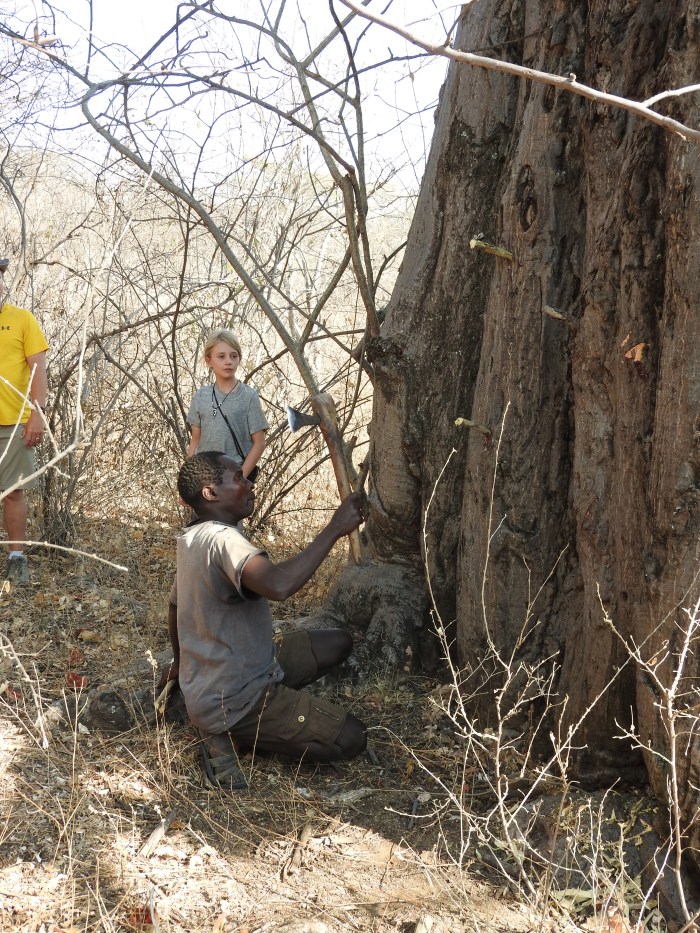
Meanwhile other Hadza started a fire by twirling their fire starting stick in softwood rapidly.


The fire makers were distracted when some bush babies ran out from their nest in a high baobab branch. One bounded to the top of another tree chased by arrows. The arrows missed and the bush baby made the bad decision to run back to the baobab. With great speed Palango was up the baobab and and grabbed the bush baby with his hands and stabbed it with his knife. He dropped the half dead bush baby down near my head just as I was facing up toward him to take a picture. By this time the fire had been started and the still twitching animal was put on the flame. Once the fur was all singed they scraped it off with a knife. After a few more minutes in the fire it was shared and eaten.


The honey gather didn’t wait for the fire to smoke out the bees, but just reached into the hive pulling out honeycombs. The honeycomb melted in your mouth completely saturated with honey leaving behind a bit of wax to be spat out.


We continued on toward their camp. The sun was beating down. The Hadzabe found our walking pace to be very slow.
We had two more honey harvests, one from angry bees that swarmed and stung the Hadzabe who seemed not to notice. We also stopped in the shade for the men to have a break and smoke some tobacco from their stone chillum style pipe.


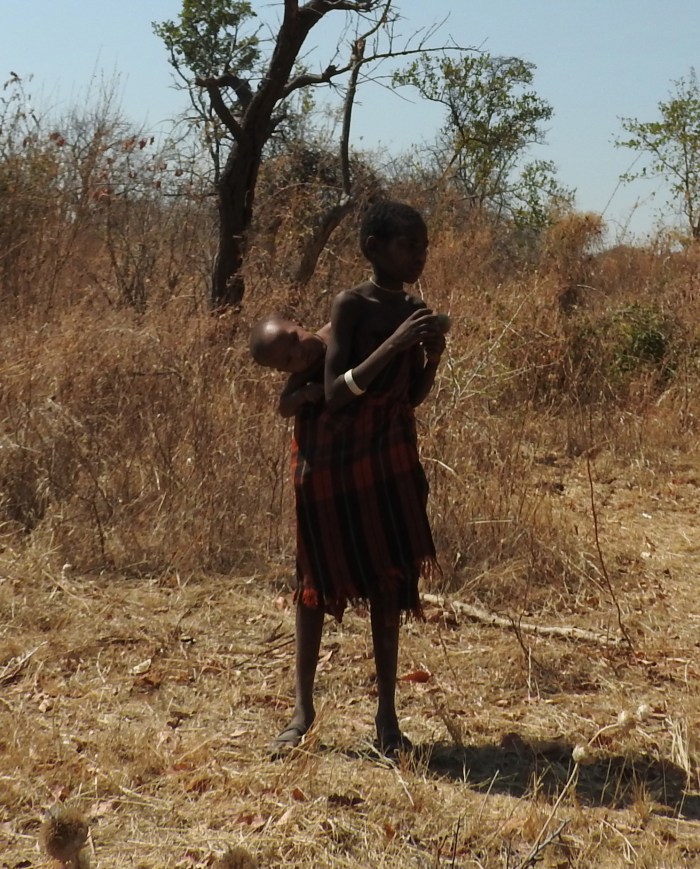
We saw cow and goat dung along the way indicating the use of the Hadzabe land by pastoralists. Sure enough we came upon a young Datoga shepherdess with her herd of cattle and a baby strapped to her back.
Farther on we came upon a larger group of Hadzabe women and babies digging a deep hole to collect tubers from a specific vine. They had a fire going and roasted the tubers after harvesting them. Once roasted the skin is peeled back. The fibrous root has a mild flavor and is chewed until only a small wad of fiber remains which is spit out. The women wore more beaded jewelry than the men including headdresses and belts. Some other men showed up with halo like headdresses made of baboon fur. The men sat in the shade near the digging women smoking marijuana and tobacco. The eldest man had a persistent rattling cough, but took enormous inhalations of tobacco regardless.


Just a bit further we visited the Hadzabe’s camp under a baobab. They are building no shelter since it is the dry season. The camp simply consisted of a few campfires. There were bones around the fires including a antelope’s hoof. The camp was set up a week ago. About 20 individuals plus babies were hanging around the camp. They will stay in this camp until January.


On the walk back to our camp for lunch, the Hadzabe men successfully shot a hyrax which they brought to the shade structure Olaseci and Kimambo had built. In minutes they had built a fire, gutted the hyrax and had it cooking. A few minutes later another man brought a thick knee (bird). He pulled out the flight feathers and put them in his hair for safe keeping for use later in arrow making. Soon the thick knee was cooked and eaten.


We had our lunch in the shade structure and spent the heat of the afternoon relaxing. A strikingly scarified Datoga woman visited our camp in the afternoon.


In the late afternoon the Hadzabe demonstrated bow and arrow making. They cut branches from a bush and charred them in the fire. Using teeth and knives they stripped the bark. They held the new arrow shafts with their toes and hands and using knives smoothed and shaped the arrows. With their teeth they straightened the arrows. Then with teeth and sinew they attached four feathers to each arrow.


Meanwhile Mpanda cold forged steel nails into sharp arrow heads. He used a specific dense rock they had brought from their camp and a heavy metal hammer. Once the nail was flattened to the approximate shape he used a steel chisel, hammering against his hatchet blade on the rock to cut the barbed arrow head shape. Again with sinew the metal arrow tip was attached to the shaft.


With his knife Gippo cut spiraling patterns in the arrow shaft and then blackened the shaft rubbing it with a charred stick from the fire. After wiping the arrow off with his shirt the cut design was revealed in black against the wood.


At the conclusion the Hadzabe delighted us by giving us the newly fashioned bows and arrows! We took turns trying them out.
The girls had bush showers before dinner. Meanwhile a handful of the Hadzabe men rolled and smoked huge marijuana joints and Joe and Carrie enjoyed a glass of wine around the fire. The men spoke animatedly in Hadzani about god knows what.
After dinner we were all in bed by 9:15 PM.
Tuesday, July 26th:
We woke early to go hunting with the Hadzabe. Jane and I went with Palango and Gippo, and Ruby, Joe and Carrie went with Scania, Jumaa, and another guy. Jane and I followed Gippo through the bush in the cool morning air. Palango would peel off and return periodically. A few times Gippo had Jane and I sit tight while he scoped out the view from a rocky outcropping. After the first hour he gave up hunting more or less and found honey at three different trees. One type of honey was in a very different waxy honeycomb and was lemony and tart. We hung out on a huge rocky outcropping for a while and could see Lake Eyasi and the Ngorongoro uplift on the other side. Palango and Gippo spent a lot of time with my binoculars there. Toward the end of the morning they spotted impala. First Palango and then Gippo with us trailing stalked the impala. A group of eight or so impala ran past and Gippo took a shot and missed. We looked for the arrow for about twenty minutes and then gave up.
Back at camp it was another hot afternoon with flies and bees buzzing us. Ruby practiced arrow making and fire building. The rest of us napped, read or wrote.
In the evening the Hadzabe helped us try and start fires using their firestick and tools.


Only Joe managed to get smoke. On his second try Joe succeed in producing an ember and starting a fire. Then we all had some target practice with bows and arrows and a cardboard box in a bush. Joe hit a bullseye on his first shot and then refused to shoot again. The rest of us were lucky if we skimmed the edge of the box. The Hadzabe enjoyed the practice more than we did taking the most shots and showing off their skills.


Meanwhile Jumaa had fashioned a set of wooden pegs and we walked to a nearby baobab. He inserted the pegs up the trunk all the way to the first branches about twenty feet up where a hole gaped into the the hollow baobab. Killerai tried a climb and the bottom peg shattered under his weight. With a new peg, Jane and Ruby both easily made it to the top despite the distance between pegs. Carrie succeeded as well. Joe and I were only brave or skilled enough to go about halfway up. Then we got all five of us on the pegs for a group picture. There wasn’t enough room, so Ruby was hoisted beyond the pegs, teetering over the hollow center in the grasp of Gippo.


After dinner, the girls and I decided to sleep out under the stars rather than in the tents. As I was putting the exhausted girls to bed, we heard raucous sing coming from the campfire. We roused ourselves and joined the group finding Joe, Carrie and Killerai hopping around dancing to the call and response songs the Hadzabe were singing. After two songs, the girls were ready for bed. I returned to the fire and caught a few more songs.
The Hadzabe wanted us to sing a song from our culture. Carrie, Joe and I were drawing a blank on a song we all knew. Embarrassingly we settled on a danceless zippity-do-da! Carrie played a little Michael Jackson from her phone, and then we thankfully returned to the the Hadzabe’s lead for a final song or two


 Family Adventures