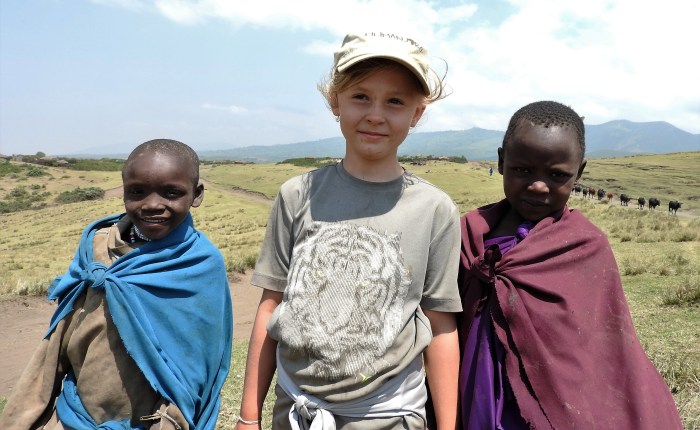
Wednesday, August 3rd:
After a slow breakfast we drove with Godlisten back along the crater rim past the road we had taken up to the other side of the crater and beyond. We saw an elephant and nice views back down into the crater. Beyond Ngorongoro we drove through a picturesque area of Maasai bomas with round buildings with thatched roofs surrounded by grassy pasture. Then we entered a vast plain of short grass with zebra and antelope with the mountain of god looming in the dusty air. In the distance shepherds drove a large flock of goats kicking up a dust cloud. Next we passed through a bushy area then into trees. The road climbed to the rim of Empakai crater and we were able to look down at the grey-green lake with it’s white salt beach far below. We arrived at our campsite on the rim and met our Maasai guide Doudi and the Summit Africa camp staff Zack, Frederick, Kennis, and Matai.
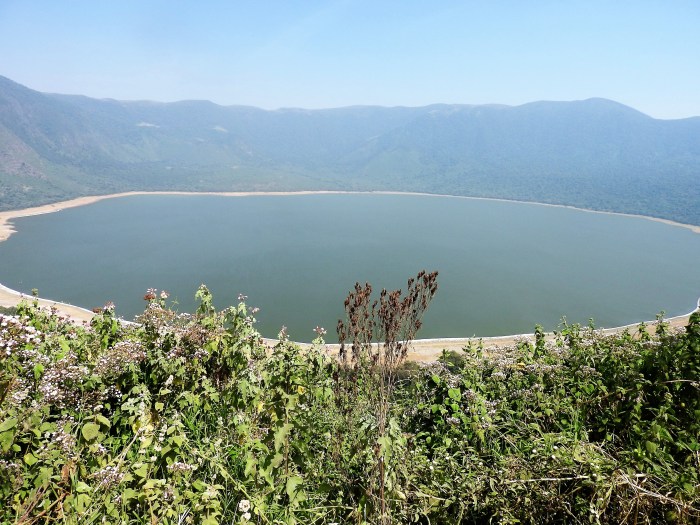
Godlisten took the majority of our stuff to meet up again in three days. We tried the goat head soup our hosts had made with the leftovers from a goat bbq they had made the previous day before beginning our hike. As we walked to the trailhead we were joined by friendly Maasai women who had come to our camp to sell beaded jewelry. Then we hiked steeply down to the crater lake with Doudi and Matai. Sunbirds chirped in the flowers at the top of the trail. The trail grew shady as we descended into a forest with large fig trees draped in vines. We emerged at the bottom and the lake shore to find one group of tourists ahead of us and another behind us.
Click on images to see larger version.


We could hear the sound of all the bells on the Maasai cattle that were grazing on the shore and the steep crater slopes. The salty lake was green from an algae growing. A few pink flamingos were along the shore and more were in the water swimming like swans. The white salt shore was covered in black hoof marks where Maasai cattle prints revealed the black volcanic soil below the salt. Maasai boys camp with their cattle in the crater for three months during the dry season. We ate our picnic lunch on the lake shore and then made our way slowly up the steep path back to camp.


We spent the afternoon hanging around camp, updating our journals, whittling, and building fires. More goat was roasted on the fire for dinner. When the goat was ready our camp population swelled as a handful of Maasai guys showed up. Zack and Kennis cut the tasty meat right off the spit and in no time the two legs and spine were eaten.


We sat around the campfire a bit watching Maasai music videos on Doudi’s phone. After dinner Ruby started feeling unwell with nasty burps and diarrhea.
Thursday, August 4th:
Zack made a potent ginger tea for Ruby in the morning. She decided she could continue with the hike despite not feeling her best.
In the early hours clouds were settled in the crater with their shadows reflected on the lake’s surface. After breakfast we began our hike with Doudi and Starder our Ranger following the small road along the top of Empakai crater. For most of the morning hike the brush along the road prevented views into the crater. Wildflowers laced the bushes attracting sunbirds.


After a couple hours the road began to drop down from the crater and we saw more and more Maasai bomas on the hillsides. The bomas are tidy with circular fences and round buildings with peaked thatched roofs, all enclosed in a circular brush fence. As we approached the town of Naiyobe there were more and more bomas, but the town itself had rectangular buildings with metal roofs. The grassy path was so rutted that we had to hop across a web of dirt crevices.


As we entered the town we were trailed by children. In the center Maasai women with armfuls of beaded jewelry surrounded us. Some of the men and women we recognized as visitors to our crater rim campsite. Doudi led us to the little duka (shop) where we purchased some shukas.
We decided we did want to purchase some bracelets. About 20 women arranged themselves seated in a circle with their wares laid out in front. We went around and looked at all the items while the women called to us. Then we bought a handful of bracelets from different sellers. At the end, an ancient woman trembling and stooped presented her bracelet, so we bought that as well. When we were done shopping Doudi helped dismiss the crowd and we ate our packed lunches on a hillside in town overlooking bomas and the primary school.


As we continued we left the conservation area and our ranger was replaced by Alex, a Maasai guide from Naiyobe. Alex was eager to talk about Maasai culture and on the fly he arranged for us to have a peek inside a boma we were passing. The surrounding brush fence has an entrance and we were invited in. We followed a path through weedy plants to two adjacent circular fences one for cows and the other goats. The corrals were empty awaiting the return of the grazing animals at sunset.
A young Maasai women invited us to take a peek inside her round hut. We needed flashlights as it was so dark. The short door required stooping and opened onto a small entrance room. To the left was an area to store firewood or young or ill animals. Ahead, in the center of the hut was a hearth consisting of a few stones and some ears of corn hung on the wall. There was no chimney. Two doors opened off the kitchen to the woman and men’s bedrooms. The woman and children sleep together on the single bed filling the small room from wall to wall. The men’s bedroom was a tiny bit bigger and included a few belongings. If the man has other wives they would have huts of their own within the boma.


As we were leaving three teenage boys wearing black shukas came up the dusty valley and entered the boma. Their faces were painted with striking white geometric designs and they wore elaborate headdresses of birds and feathers. The boys had been circumcised recently and wear the black shuka and face paint for a few months to celebrate the milestone that initiates them as warriors. After the boys are circumcised with their cohorts every 8-12 years they hunt birds and then make headdresses from the birds to show off their prowess. One of the boys had a headdress with a long wire reaching from his forehead with a plume of ostrich feathers at the end, like a unicorn with a feather duster for a horn. The back side of the headdress had 10 or more robin chats lined up in a row.
We continued our dusty descent on footpaths. Eventually we dropped into a forest of yellow barked acacia trees. Two persistent Maasai children followed us hoping to sell some jewelry: Luka and Mary. We arrived at our camp which was still being set up. The donkeys who carried the gear were grazing here and there. We had some new guys that came with the donkeys including a friendly one named Uldutinga. All afternoon Maasai came by looking to sell beaded jewelry or just checking us out.


Ruby began trying to start a fire the Hadzabe way with just a stick and dried grass. Joe joined the effort. Finally Uldutinga intervened rapidly fashioning a new fire stick and producing an ember just as well as the Hadzabe. We spent the evening mingling with the Maasai around the fire.
Friday, August 5th:
After breakfast we said goodbye to our Summit Africa camp team and headed out of the acacia forest. We traveled a dusty path across grassy mountains along a steep ravine with Oldonyo Lengui, a dramatic volcano, looming over. The air was so full of dust we could barely make out Empakai crater behind us. Occasionally we encountered Maasai men with their donkeys heading from Lake Natron to the market at Naiyobe. The younger men, the warrior generation, wore their hair in elaborate braids and wore beaded white earrings in their stretched earlobes.


They way became very steep as we slid down the mountains in the volcanic ash dust. All of us slipped and fell. The wind and our feet blew up dust clouds. Finally we made it to the bottom and took a short break in a dry creek carved in the old ash and lava. From there it was another hour across a grassy plain cut with dry washes to reunite with Godlisten and the car. We said goodbye to Alex and Uldutinga and drove through the dusty barren landscape past occasional bomas to the Lake Natron camp.


The black shade cloth tents of the camp were on a plain of short grass and black lava rock. The wind whistled constantly. A marsh and creek ran alongside the camp to lake Natron. Right away we went for a swim in the small “pool” which was a shallow dammed up portion of the creek with a shade tent alongside. The water was swift, warmish, clear and full of small fish that nibbled on our feet.


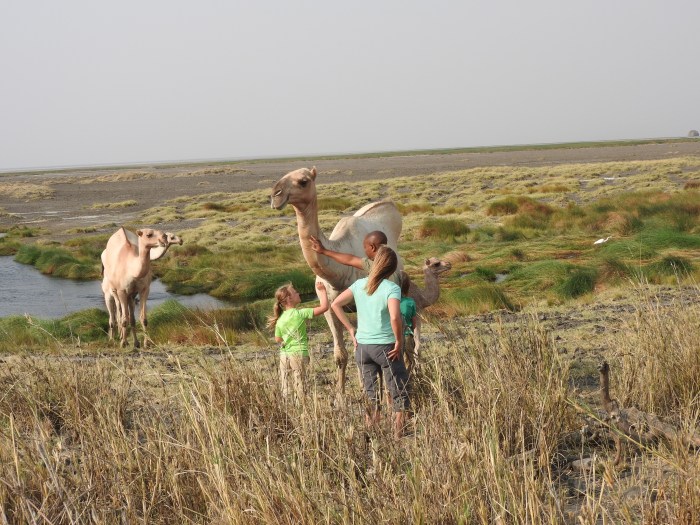
We got ourselves cleaned up a bit and spent the late afternoon lounging in the mess tent reading and writing. The camp camels came close by and we got to pet the mama of the two week old baby camel.
In the evening Doudi led us on a walk to lake Natron. We took off our shoes repeatedly to cross streams leading to the salt lake. We walked across the salt crusted cracked mud to the lake’s edge where flocks of both greater and lesser flamingo fled our presence. The sun set into the dusty air and we headed back for dinner at the camp.


All night long the wind blew rattling the tent whipping ropes and strings.
 Family Adventures