Lake Manyara National Park

Wednesday, July 27th:

Sleeping outside we had a great view of the stars and later the sunrise.  In the morning we packed up and said our goodbyes to Kimambo, Oleseci and the Hadzabe. We exited the Yaida Valley to the north driving on “roads” with no tire tracks and seeing a few other Hadza on the way.  Killerai was still identifying new bird species as we went.  Finally we climbed out of the valley, into Iraqw farmland and then to the main road.  We passed through the town of Karatu to the Wayo office in Mto wa Mbu where we ate our picnic lunch with Killerai.

After lunch we met our new Wayo guide Godlisten.  We were sad to say goodbye to Killerai.  With Godlisten we entered Lake Manyara National Park.  The park entrance was circled by hundreds of yellow billed storks that roosted in the trees. We enjoyed a long game drive across the park through dark forests and along the lake shore.

The camp was located in the Endabash riverbed along the dramatic rift valley wall.  The river  dramatically entered the valley as a tall narrow waterfall with a steep top and boulder strewn bottom. Baboons and elephants frequented the river right in front of our camp. We joined a Dutch couple around the fire and later for dinner on the river bed.

Thursday, July 28th:

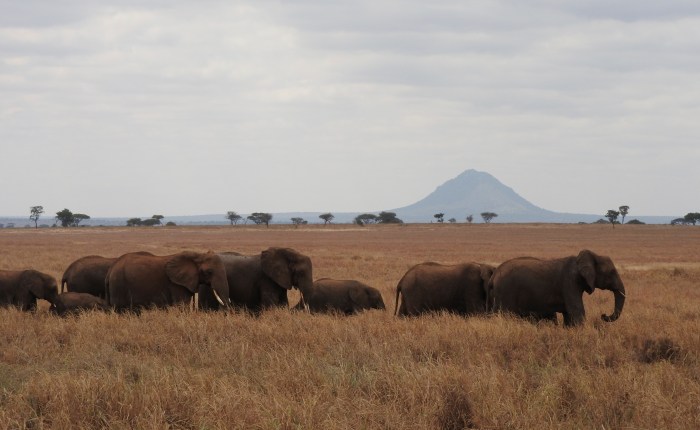
In the morning as we got ready and ate breakfast on the riverbed scores of olive baboons came out of the trees and hung around the riverbed.  Then six elephants made their way upstream drinking from the river.

Next we did a morning game drive with Godlisten.  First we visited a spot where a hot sulphurous spring emerges and empties into the muddy Lake Manyara. On the lakeshore were wildebeest and zebra and tons of white pelicans and yellow billed storks. We walked out on a pier over the lake.  From there we drove on game drive circuits in the woodlands enjoying a few elephant sightings.  The last part of the drive the road went along the dramatic rift valley wall.

Back at camp for lunch the girls and I climbed around the boulders and waterfall.  We made it about halfway up before returning for lunch.  Lunch was set up in the shallow water of the river under the shade of sycamore fig and acacia trees.  The afternoon was scorching hot, but in the shade with our feet in the cool water it was very pleasant.

After lunch we climbed back up the waterfall boulders.  We had to wait a half hour for a huge baboon river crossing before Carrie could join us. We made our way up the boulders to an area with a larger pool and the steep part of the waterfall which was surrounded by vertical slick rock.  The girls took a dip in the pool of colder perhaps spring water.  Then we all ran in and out of the waterfall before descending slowly down the rocks.

After dinner we joined a Canadian couple on a night game drive.  Jane fell asleep in Carrie’s shoulder immediately and was sad to miss out.  The rest of us were also dozing. Using a large spotlight we saw bush babies, mongoose, civet, giraffe and elephant.  We also got a flat tire and returned to camp very late and exhausted

The Hadzabe of the Yaida Valley

The Hadzabe of the Yaida Valley

Sunday, July 24th:

In the morning we enjoyed a final game drive in beautiful Tarangire national park before exiting into the adjacent Maasai pasture lands and villages. Along the road we saw Maasai boys dramatically dressed in black with white geometric face painting signifying their recent circumcision and new status as warriors.

Our path climbed up from the rift valley steeply into the Mbulu highlands. We saw more farming and were reminded of the Usambara mountains.  We stopped for a picnic lunch. We crossed the highlands and began descending into the Yaida valley.  The Irawq people living here built low rectangular mud homes hidden behind brush fences.

Click photos to see larger image

The bottom of the Yaida valley is the Yaida swamp which is almost entirely dried up by July.  Datoga tribesmen were grazing larger animal herds on the flat and dust dried up swamp.  The small portions of the swamp that still had water were packed with waterfowl including flamingos.  

We passed scattered Datoga bomas until finally coming upon a Hadzabe camp with its minimal temporary shelters made of sticks and grass.  The mostly women and children crowded around our car greeting each of us through the windows.  Many of the boys carried bows and arrows.  These Hadzabe were to help us find the camp we would be visiting with.  A teenage boy hopped on the roof of the car to direct us to where in the bush we’d find our camp that Kimambo and Oleseci had set up.  We stopped repeatedly to allow him to retrieve the arrows he shot at birds as we drove.  He took four or five shots, all near misses.

We climbed off road, up a ridge with acacia trees and rocky ground.  We stopped and a man and women appeared.  We followed them into the bush and met Scania a Hadzabe man and his neighbor a Datoga women.  Scania had recently hunted an impala.  He was cooking up some of it in a pot with his wife and two little kids (his property per direct translation) in his camp which consisted of a bush and a fire ring.  He showed us the horns and skull and we helped him unstake the hide which had been dried in the sun.  He insisted that Killerai take some of the impala meat to enjoy at our camp and we continued on our way as the sun set behind the acacias.

Kimambo and Oleseci and had up three tents, a shower, a latrine, a mess tent and a shade structure.  The Hadzabe had recently burned the area leaving the ground charred.  There were large fantastic rock out-croppings right next to the tents.  After dark the stars were amazing.

Monday, July 25th:

The girls watched the sunrise from atop one of the uplifted rocky outcrops.  I did a bit of bucket laundry.  It took us a while to get ready after breakfast and the Hadzabe were waiting.  With Killerai as translator we reviewed the tools and weapons the Hadzabe had with them.  Simple bows strung with sinew or nylon and decorated with zebra or baboon fur.  The bows were about 4 ft. across and strung tight making it difficult to pull the bowstring back.  They had a variety of arrows.  One had a blunt end made of corn cob for knocking out small birds without puncturing their bodies.  There were arrows with ends of just the sharpened shaft for small game like bigger birds and hyrax.  Some of these had a spiral or barbs carved in to ensure they stayed in the prey. There were arrows with long narrow metal arrow tips made from cold working a nail.  Then there were the wide triangular metal arrow tips painted with a lethal poison made from the desert rose plant.  They also had a club shaped hatchet whose backside functioned as a hammer and a fire starting stick in addition to several knives sheathed in animal hides worn on their bodies.  Each type of arrow had different expertly attached feathers.

We set out with six Hadzabe guys to gather honey from a hive that had been identified in a baobab. They continuously took shots at doves and other birds without success as we went.  Within minutes Mpanda was hacking away at a tree limb.  He had spotted a wax tube emerging from a branch indicating a beehive. He hacked the branch open and pulled out honeycomb offering us pieces of dripping with the stingless bee honey.  It was a small honeycomb and delicious.  Once the honey was eaten we spit out the wax.  The Hadzabe ate the larvae as well.

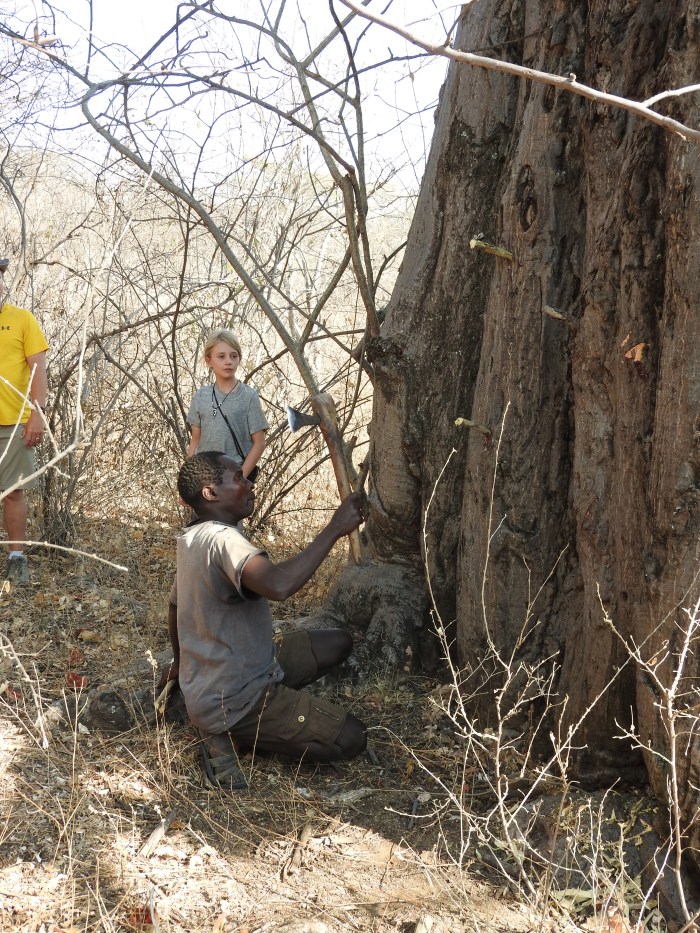
Mpanda then began whistling to a honey guide bird who chittered back.  We deviated to follow the honey guide who brought us to a hive in a baobab that had already been harvested.  From there we continued through the brush to a baobab with bees buzzing in and out of a hole about twenty feet up.  The baobab had wooden pegs hammered into the trunk from prior honey harvests.  The men began quickly fashioning new wooden pegs with their knives and hatchets.  Once they had enough pegs, one Hadza began knocking out the older pegs.  He made a fresh cut in the trunk with his hatchet, inserted a peg and hammered it in.  He then climbed up the pegs inserting them as he went.

dscn3715

Meanwhile other Hadza started a fire by twirling their fire starting stick in softwood rapidly.

The fire makers were distracted when some bush babies ran out from their nest in a high baobab branch.  One bounded to the top of another tree chased by arrows.  The arrows missed and the bush baby made the bad decision to run back to the baobab. With great speed Palango was up the baobab and and grabbed the bush baby with his hands and stabbed it with his knife. He dropped the half dead bush baby down near my head just as I was facing up toward him to take a picture.  By this time the fire had been started and the still twitching animal was put on the flame.  Once the fur was all singed they scraped it off with a knife.  After a few more minutes in the fire it was shared and eaten.

The honey gather didn’t wait for the fire to smoke out the bees, but just reached into the hive pulling out honeycombs.  The honeycomb melted in your mouth completely saturated with honey leaving behind a bit of wax to be spat out.

We continued on toward their camp.  The sun was beating down. The Hadzabe found our walking pace to be very slow.

We had two more honey harvests, one from angry bees that swarmed and stung the Hadzabe who seemed not to notice.  We also stopped in the shade for the men to have a break and smoke some tobacco from their stone chillum style pipe.

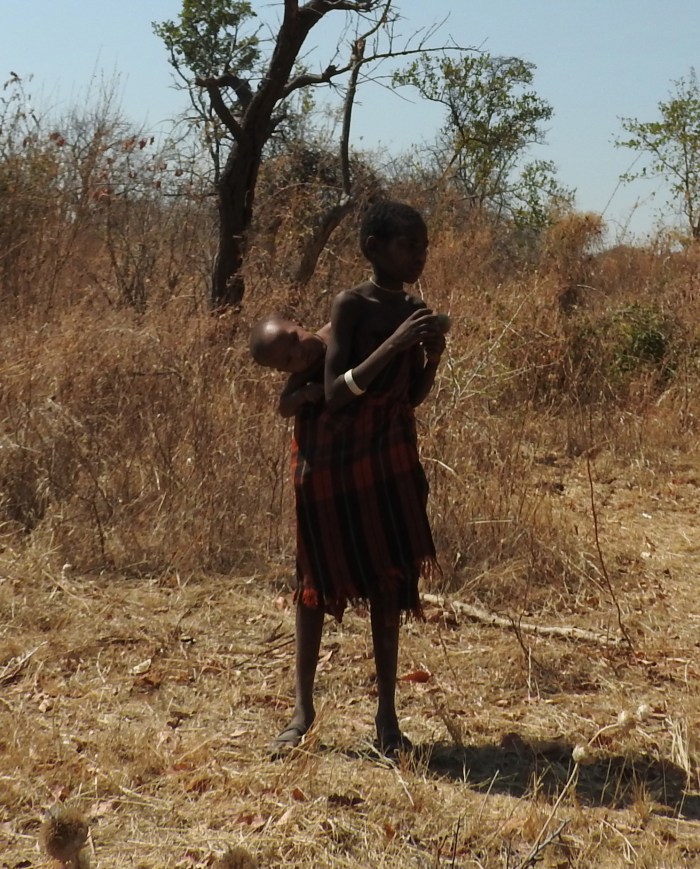
We saw cow and goat dung along the way indicating the use of the Hadzabe land by pastoralists.  Sure enough we came upon a young Datoga shepherdess with her herd of cattle and a baby strapped to her back.

dscn3763

Farther on we came upon a larger group of Hadzabe women and babies digging a deep hole to collect tubers from a specific vine.  They had a fire going and roasted the tubers after harvesting them.  Once roasted the skin is peeled back.  The fibrous root has a mild flavor and is chewed until only a small wad of fiber remains which is spit out.  The women wore more beaded jewelry than the men including headdresses and belts. Some other men showed up with halo like headdresses made of baboon fur.  The men sat in the shade near the digging women smoking marijuana and tobacco.  The eldest man had a persistent rattling cough, but took enormous inhalations of tobacco regardless.

Just a bit further we visited the Hadzabe’s camp under a baobab.  They are building no shelter since it is the dry season.  The camp simply consisted of a few campfires.  There were bones around the fires including a antelope’s hoof. The camp was set up a week ago.  About 20 individuals plus babies were hanging around the camp.  They will stay in this camp until January.

On the walk back to our camp for lunch, the Hadzabe men successfully shot a hyrax which they brought to the shade structure Olaseci and Kimambo had built.  In minutes they had built a fire, gutted the hyrax and had it cooking.  A few minutes later another man brought a thick knee (bird).  He pulled out the flight feathers and put them in his hair for safe keeping for use later in arrow making.  Soon the thick knee was cooked and eaten.

We had our lunch in the shade structure and spent the heat of the afternoon relaxing. A strikingly scarified Datoga woman visited our camp in the afternoon.

In the late afternoon the Hadzabe demonstrated bow and arrow making. They cut branches from a bush and charred them in the fire.  Using teeth and knives they stripped the bark.  They held the new arrow shafts with their toes and hands and using knives smoothed and shaped the arrows.  With their teeth they straightened the arrows.  Then with teeth and sinew they attached four feathers to each arrow.

Meanwhile Mpanda cold forged steel nails into sharp arrow heads.  He used a specific dense rock they had brought from their camp and a heavy metal hammer.  Once the nail was flattened to the approximate shape he used a steel chisel, hammering against his hatchet blade on the rock to cut the barbed arrow head shape.  Again with sinew the metal arrow tip was attached to the shaft.  

With his knife Gippo cut spiraling patterns in the arrow shaft and then blackened the shaft rubbing it with a charred stick from the fire.  After wiping the arrow off with his shirt the cut design was revealed in black against the wood.

At the conclusion the Hadzabe delighted us by giving us the newly fashioned bows and arrows!  We took turns trying them out.

The girls had bush showers before dinner.  Meanwhile a handful of the Hadzabe men rolled and smoked huge marijuana joints and Joe and Carrie enjoyed a glass of wine around the fire.  The men spoke animatedly in Hadzani about god knows what.

After dinner we were all in bed by 9:15 PM.

Tuesday, July 26th:

We woke early to go hunting with the Hadzabe.  Jane and I went with Palango and Gippo, and Ruby, Joe and Carrie went with Scania, Jumaa, and another guy.  Jane and I followed Gippo through the bush in the cool morning air.  Palango would peel off and return periodically.  A few times Gippo had Jane and I sit tight while he scoped out the view from a rocky outcropping. After the first hour he gave up hunting more or less and found honey at three different trees.  One type of honey was in a very different waxy honeycomb and was lemony and tart.  We hung out on a huge rocky outcropping for a while and could see Lake Eyasi and the Ngorongoro uplift on the other side.  Palango and Gippo spent a lot of time with my binoculars there. Toward the end of the morning they spotted impala.  First Palango and then Gippo with us trailing stalked the impala.  A group of eight or so impala ran past and Gippo took a shot and missed.  We looked for the arrow for about twenty minutes and then gave up.

Back at camp it was another hot afternoon with flies and bees buzzing us.  Ruby practiced arrow making and fire building.  The rest of us napped, read or wrote.

In the evening the Hadzabe helped us try and start fires using their firestick and tools.

Only Joe managed to get smoke.  On his second try Joe succeed in producing an ember and starting a fire.  Then we all had some target practice with bows and arrows and a cardboard box in a bush.  Joe hit a bullseye on his first shot and then refused to shoot again.  The rest of us were lucky if we skimmed the edge of the box.  The Hadzabe enjoyed the practice more than we did taking the most shots and showing off their skills.

Meanwhile Jumaa had fashioned a set of wooden pegs and we walked to a nearby baobab.  He inserted the pegs up the trunk all the way to the first branches about twenty feet up where a hole gaped into the the hollow baobab.  Killerai tried a climb and the bottom peg shattered under his weight.  With a new peg, Jane and Ruby both easily made it to the top despite the distance between pegs.  Carrie succeeded as well. Joe and I were only brave or skilled enough to go about halfway up.  Then we got all five of us on the pegs for a group picture.  There wasn’t enough room, so Ruby was hoisted beyond the pegs, teetering over the hollow center in the grasp of Gippo.

After dinner, the girls and I decided to sleep out under the stars rather than in the tents. As I was putting the exhausted girls to bed, we heard raucous sing coming from the campfire.  We roused ourselves and joined the group finding Joe, Carrie and Killerai hopping around dancing to the call and response songs the Hadzabe were singing.  After two songs, the girls were ready for bed.  I returned to the fire and caught a few more songs.  
The Hadzabe wanted us to sing a song from our culture.  Carrie, Joe and I were drawing a blank on a song we all knew.  Embarrassingly we settled on a danceless zippity-do-da!  Carrie played a little Michael Jackson from her phone, and then we thankfully returned to the the Hadzabe’s lead for a final song or two

Tarangire National Park

Tarangire National Park

Wednesday, July 20th:

Our new guide Killerai picked us up in a big Land Cruiser after breakfast. We drove all day to our camp at the southern end of Tarangire National Park. First we passed along the dusty congested road under construction through Arusha. Turning south from Arusha we joined dust spewing dump trucks full of sand for the road construction project.

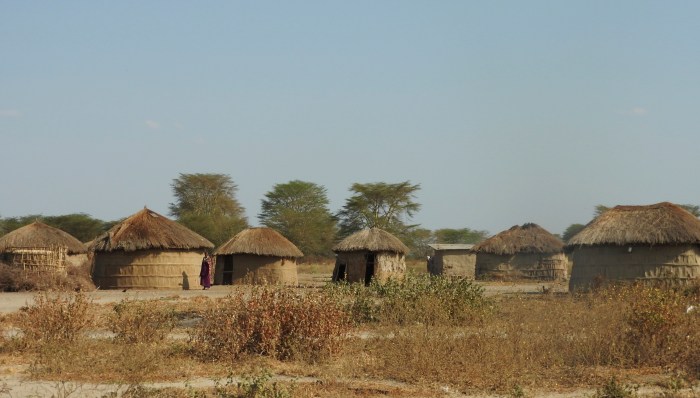
Finally we left the trucks behind and continued past dry countryside with occasional corn fields, goat and cow herds with shepherds, and Maasai bomas. The bomas typically had a surrounding fence of bushes with round huts plastered with cow dung with thatched roofs.  We seemed to be the only car on the road and all we passed waved to us.  Many we saw were Maasai dressed in shukas, some with stretched earlobes adorned with elaborate beaded earrings.

DSCN3025DSCN3026

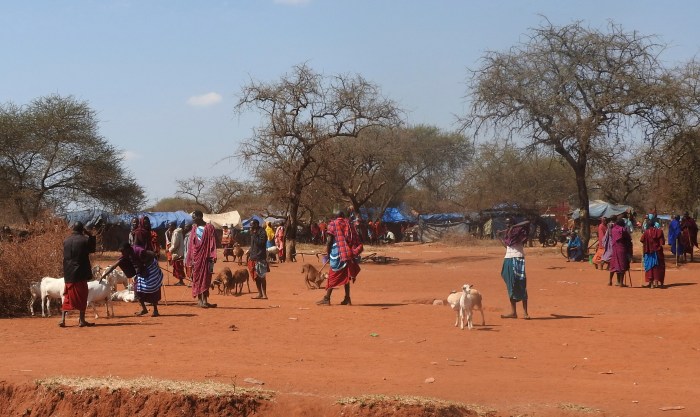
We passed some wells surrounded by people with donkeys and jerry cans to carry water.  We also passed a bustling Maasai market with tons of animals and people, but were in too much of a hurry to stop.

DSCN3011DSCN3013

Along the way we saw many birds, more 50 species.  We also saw grant’s gazelles and a large group of ostrich.  Once a swarm of bees flew across the road.  Some controlled burns in the park blocked our route and we took a slightly longer route to our tree nest and camp.  Once in Tarangire national park, our car was swarmed with tsetse flies and we had to roll up the windows and turn on the AC. We spotted zebra, a lesser kudu and an elephant from afar before arriving at the tree nest.

The tree nest is in a small green tree alongside a pond.  At this time the watering hole is large and there are others nearby.  The tree is easily climbed and the branches have been pushed down, more sticks added, and canvas laid on top.

This slideshow requires JavaScript.

After checking out the nest we continued on to the camp Kimambo and Oleseci had set up, snacking on chips and beer before dinner. Beautiful superb starlings ran around our camp.

Click photo to see larger version

After dinner we drove over to the tree nest where the guys had set up our mattresses.  We sat quietly in the dusk and watched the moon rise above the watering hole. Unfortunately no game appeared at the watering hole and we drifted off to sleep one by one.

This slideshow requires JavaScript.

Thursday, July 21th:

I woke many times during the night.  The bright full moon was higher each time, but still no animals arrived.  We were tossing and turning before dawn and sitting up to the beautiful sunrise over the watering hole.  We saw plenty of birds coming and going, but no mammals.  A flock of egyptian geese flew right at us, swerving away at the last minute.

Eventually we climbed down and walked the short distance back to camp for coffee and breakfast. After breakfast we had a four hour walk with Killerai and Chris, a park ranger, each armed with rifles.  We circled the watering hole and then hiked along the road to another watering hole. We are the only people anywhere in the area.  We saw a few animals from afar including elephant, waterbuck, giraffe, and monkeys. It was great to be on foot and see smaller details like prints, scat, feathers, seedpods, beautiful porcupine quills and praying mantis egg sacks.  A honey guide bird led us to a big honeycomb covered with bees. We inspected an old hanging weaver nest and found a cute little golden mouse inside.

Click photo to see larger version

After returning, we had a camp lunch.  We spent an afternoon sitting in the shade updating our journals or reading.

Click photo to see larger version

After an early dinner we returned to the tree nest.  Unfortunately again, no animals showed up to the watering hole.  Worse, the breeze cut out in the middle of the night leaving us hot and swarmed with mosquitos.

Click photo to see larger version

It was great to have the entire southern Tarangire park to ourselves – really off the beaten path bush camping.  But because there was a lot of rain this year, and the dry season is just starting, the animals were dispersed and hard to find.

Friday, July 22th:

We were already to quit the mosquito ridden tree nest by dawn.  After breakfast at camp we drove all day north the length of Tarangire National Park.  All morning we still saw no other people.  We slowly crossed a large dried up swamp on a very bumpy, faint track. Finally across the swamp, we drove along a ridge through bushy terrain where the tsetse flies were so bad we rolled up the windows. In this area we saw our first herd of elephant.

We descended the hills to another dried swamp with a large herd of elephant, more than 30 including some little ones. Once we got closer we found there were four lionesses in the tall grass in the path of the elephants.  There were a couple other safari vehicles, the first we’d seen in days. As we watched the lionesses moved to cut off the elephant.  Three continued to the side and one stalked toward them crouching to be invisible in the blond grass.  Just then a safari car began loudly reversing cutting the three lionesses off from the elephants and the other lion.  The elephants became wary.  The lone lioness continued to stalk for a bit, but then sat down sleepily.

Click photo to see larger version

We continued and saw herd after herd of elephants.  After a picnic lunch, we drove all afternoon across the park seeing elephant, waterbuck, impala, zebra, gnu and hyrax.  What a contrast to the southern portion of the park; there was wildlife everywhere, along with safari vehicles.  

Click photo to see larger version

In the late afternoon we reached the fabulous Tarangire Safari Lodge built on a ridge overlooking the Tarangire river.  The girls had a swim in the pool and everyone enjoyed delightful and much needed hot showers.  On the path along the tented rooms and giant baobabs I saw vervet monkeys, an impala, a warthog, and a dik dik.

IMG_3249IMG_3252

Before dinner we had drinks on the patio entertained hornbills, starlings, and weaver birds.  After the buffet dinner and putting the girls to bed, Joe, Carrie and I hung around the dying fire on the patio amazed by the stars and milky way.

Saturday, July 23rd:

After breakfast we spent the morning game driving on the river circuits with Killerai.  At a water hole a huge herd of gnu (wildebeest) ran noisily and chaotically in to drink and swim.

Click photo to see larger version

Again we saw so many elephants from very close range.  One big group in the Tarangire river included a bull digging in the sand for the preferred “filtered” water, and another huge bull had one tusk so large it almost touched the ground.  We found groups of olive baboons whose males have large shoulders and a lion’s mane of fur. We continued to spot new bird species bringing the count for Tarangire up to 140.

Click photo to see larger version

We had lunch and spent the afternoon at the lodge.  The girls enjoyed the swimming pool after lunch. From the deck we could easily see many elephants parading in the bush below or drinking in the river.  In the blooming aloes of the lodge were scarlet chested and violet backed sunbirds.  

Click photo to see larger version

We did the “little Serengeti” circuit for our evening game drive with Killerai.  The grassy plain was full of elephant, zebra, wildebeest and more.  Carrie spotted a cluster of safari vehicles and we were able to see two cheetah when they momentarily sat up in the tall grass. After leaving the cheetah, Killerai accidently took a long turn and our game drive lasted into the dark returning twenty minutes after the 7 PM curfew.  The zebra and elephant crossing the road before us were even more thrilling in the dark.

Click photo to see larger version

Ruaha National Park

Friday, July 15th:

While we were packing up to leave Selous, we realized a young bull elephant was right outside our tent.  We unzipped to take a look from the porch.  The elephant faced us, put his ears out, trumpeted, and made a slow false charge toward the tent as we scrambled back inside.  He made a few more threatening lunges and then did the same to the neighboring tent for good measure.  Then he went to a palm tree growing at a slant and put his leg over and rubbing got a serious crotch scratch. He repositioned with a front leg over for an armpit scratch.  After making a few more threatening charges and throwing some palm fronds around he departed.

Samwel and Daniel took us on the hour long drive to the airstrip where we found our small plane waiting. They weret a great guide and driver pair and will be a tough act to follow. They waved to us from the land rover as our plane took off.

The 1.5 hour flight to Ruaha was smooth enough.  Ours was the second airstrip so we had to take off and land twice.  The take-offs from the bumpy, inclined airstrips are thrilling enough, but the landings are perilous.  The pilot must circle the airstrip once to ensure no stray giraffes, zebra or elephant are in the way.  The circling involves steep banking such that the small plane is literally sideways. I am white knuckled and sweating.  The spotting of several large herds of elephant before even landing was a welcome distraction.

Our new guide Kahimba met us at the airstrip along with Henry, a guide in training. The airstrip is a long way from the camp, so we had an all day game drive with a picnic lunch arriving at camp around 6:30 PM. Immediately it was clear the ecosystem was entirely different from Selous.  We crossed hills of high bushes (not the acacia of Selous), very tall grasses and many medium sized baobabs.  We saw some zebra, warthogs, and kudu, but they were harder to spot in the denser vegetation.  All the baobab were severely scarred on their lower halves where elephant routinely strip the bark with their tusks in the dry season to chew for water. Another big difference is that in Ruaha, as in all national parks, the cars must stay on the roads whereas at Selous, a game reserve, the cars are free to drive wherever.  Ruaha’s grassy undergrowth looks to benefit from this rule.

We eventually dropped down into the Mwangu river bed spotting herd after herd of elephants much larger than those we’d seen in Selous. The river itself was a narrow trickle in a wide sandy bed.  Along with the elephant we saw troops of baboons and banded mongooses in the river bed.  We also found a great diversity of birds counting almost 50 species, many we’d never seen before.  The abundance of elephants was euphoric.  At every turn we encountered them, from babies to large tusked bulls.  They dug and drank water from under the sandy river bed.  They grazed on the tall river bank grasses which they pulled out with a twist of the trunk.

Leaving the river bed we travelled uphill through bush country.  We travelled fast in this tsetse fly zone.  Elephant dung was smoking from a container attached to the back of the vehicle to discourage the biting flies.  We saw giraffe and adorable baby impala bouncing with their herd in the baobab forest. As we climbed and dusk fell the air grew cooler and the trees grew larger.  We began to see some big trees and dense bushes and then a beautiful male bush buck..

We arrived at the tented camp and enjoyed our dinner outside with the other guests.  They had made a birthday cake and sang for Ruby.  We all donned our coats for the first time since the Usambara mountains.  Hot coals under the dinner table and hot water bottles and thick blankets for our beds made the cool temperatures a treat.

Saturday, July 16th:

There was notably less birdsong at dawn than in Selous. Mostly we heard the chirps of insects and the songs of doves from afar.  The tent was darker because we’d closed all the flaps against the cold. Still we were up to early, tossing and turning before dawn.

At breakfast with our hosts Rebecca and Andres, the table was covered in bees. Ruby had to continually move bees aside from her breakfast of pancakes (crepes) and honey.  A rascally vervet monkey lingered at the tent’s edge hoping to get some fruit cocktail.

We had an all day game drive with Kahimba and Henry. We began driving back the way we came down from the higher country.  With a goal of identifying 100 bird species we stopped frequently. The huge eagle owl we saw was amazing.

Kahimba got a call that a leopard had been spotted.  Although it was a long ways off we decided to go for it.  We drove at a good pace passing along a beautiful little mountain ridge full of granite boulders and outcroppings and flowering trees.  We saw the prints of a leopard dragging prey in the sandy road.  Finally we came to the baobab tree where the leopard had been spotted to find it gone having walked off into the bush.  Kahimba decided to pursue a bit further, illegally driving off the road. We were rewarded with a great although brief view of the leopard relaxing in the shade of another baobab and then stalking away through the tall blond grass.  The animal was big and incredibly beautiful.

We continued to the Ruaha river where we watched a herd of 10 bull elephants drinking and sparring with their tusks.  We drove along the Ruaha under a canopy of acacia shaped like umbrellas observing the wildlife in the river.  Suddenly we saw two impala running fast chased by a lioness.  The impala got away. Later we saw more lions sleeping in the shade in the heat of the afternoon.  We also saw rock hyrax, tiny dik dik antelope, grant’s gazelle, and fox like jackels over the course of the day.

We enjoyed drinks around the fire with the other guests and dinner set up in the dry river bed.

Sunday, July 17th:

We had another all day game drive with Kahimba and Henry.  Soon after leaving camp we encountered four bull elephants in the road.  We watched them for a long time as they shook an apple ring tree vigorously until the ripe seedpods rained down.  Then they deftly picked up each one from the ground with their trunk and ate it.  After about seven rounds of shaking and eating, the elephants moved on.

We continued down the road and before long came upon three of the camp’s staff on foot.  Their car had broken down including the radio and they were attempting to return to camp on foot, but found themselves amidst the bull elephants, the youngest of which was trumpeting and had his ears up.  We gathered the scared guys into our car, radioed the camp to send a car to them, and drove them back to their vehicle.  Along the way we stopped to see a large herd of buffalo in the riverbed the guys had spotted.

We drove through the many landscapes and ecozones of Ruaha park.  A highlight was passing through a forest of tall umbrella shaped acacia and being flanked by running giraffes.  We stopped for lunch in a spot full of dramatic boulders standing at precarious angles.  The girls enjoyed being out of the car and scampering around the rocks.  In the afternoon we checked out a large hollow baobab that had been an owl’s nest.  The floor was littered with the tiny bones and skulls of ground squirrels.

We continued to identify birds in the quest for 100 species.  Some favorites are the red billed ruaha and crowned hornbills, the bare faced go away birds, and the many large birds of prey.

In the evening we had a little down time before dinner.  In the early part of the night I heard an elephant dismembering a tree near our tent.

Monday, July 18th:

On our final 1.5 hour drive from the camp to the airstrip we finally spotted ostrich.  The male was huge and easily spotted in his bold black and white feathers and pink neck of the breeding season.  The female was camouflaged in dusky grey feathers.  Later in the season, the female will sit on the eggs by day and the male by night, each with plumage appropriate for disguise.

Kahimba and Henry saw us off on a little jet to Arusha.  This plane seats fewer, but flies higher and faster.  A driver met us at the airport and delivered us to Rivertrees, a lodge on the outskirts of Arusha. The road was under construction, congested and very dusty.  It was a slow ugly slog through Arusha.

Rivertrees was an oasis from the road.  The larger property sits on the fast flowing Usa river.  Large trees, some with monkeys, line the river and dot the lodge.  In the late afternoon, Carrie arrived.  The adults spent the day relaxing in the restaurant enjoying the first good wifi we’d had in weeks. The girl spent the day on the foot trail along the river finding forts and mapping their thorn and flora hollow spots.

Tuesday, July 19th:

We spent the morning around Rivertrees while Carrie slept in after her travels. In the afternoon a guide named Gabriel led us canoeing around Lake Duluti on the outskirts of Arusha. The crater lake opaque green water is full of birds. We identified 23 species.  We also saw large monitor lizards swimming and sunning on logs. Mt. Meru’s sharp peak rose over the lake and Mt. Kilimanjaro was also visible but further.

We enjoyed another relaxing evening at Rivertrees.  The grownups at the restaurant, the kids in the riverside woods.

Selous

Monday, July 11th:

In the morning we enjoyed the palm swifts zooming around and the mangrove kingfisher posing near the porch.  We had a final breakfast with Anne and Livia under the tamarind tree.  The girls spent the morning with Livia while Joe and I packed up.

We boated back to Mafia getting our final splashings of salt spray.  Then we had a short van ride across the island followed by a short flight to Dar with a bumpy finish.  We killed 2.5 hours in the Dar airport which is pretty basic.  Our second flight was from the high rises of Dar to the enormous wilderness expanse of Selous.  From the plane, as far as the eye could see, there was no sign of humans until the clearing of the landing strip.  We saw a shimmering river and lake network surrounded by tall palms.  Further from the water were plains dotted with trees. Ruby spotted zebra and Jane spotted impala before the plane had even touched down.

Our tented safari lodge guides zoomed up in an amazing open vehicle.  Before the airstrip was out of view, we saw giraffes, impala, warthogs and hyena in a den with cubs.  We took a long time getting to the camp stopping continuously to watch the prolific wildlife in the sunset light. Along the way we saw wildebeest, cape buffalo, baboons, and so many species of colorful birds, notably the glossy blue eared starling and the lilac breasted roller.  Samwel, our guide, was incredibly knowledgeable and charming.

We finally reached the camp at dusk.  Once registered and oriented by the managers from South Africa, Shaun and Millie, we were escorted to our family tent by a Maasai.  We waited in our tent getting situated until a Maasai picked us up to escort us to dinner.  We are not allowed to walk unescorted at night.  

We joined the hosts and a Dutch family of four at a large table under the stars with fires on either side for a dinner of ginger chicken, our first non seafood meal in many days.  A beautiful genette showed off climbing up and down a palm trunk during the meal.  Exhausted, we went straight to bed after dinner.  I was up many times at night listening to animal sounds and the tremendous birdsong come dawn.

Tuesday, July 12th:

Unable to ignore the animal and bird sounds any longer we began to stir.  We heard loud cracking sounds and then saw an elephant nearby through the mesh of the tent window!  Before long we were out on our little porch watching a family of elephants, small in stature, walk past.  One turned to face us and approached and we all scrambled back in the tent until it lost interest.  We also saw a hippo grazing with a white egret across the water and many vervet monkeys, including babies, scampering around the doum palms overhead.  One was jumping around on the roof of the adjacent tent.

After breakfast at the restaurant, we spent the morning on a game drive.  We identified at least 40 species of birds which Ruby dutifully recorded in her journal.  We found a pair of lionesses and cubs sleeping in the shade of a palmetto bush and drove within a few feet.  We spotted a lone female kudu. We encountered the ubiquitous impala and skittish herds of wildebeest and zebra.  We saw many graceful groups of giraffe and areas thick with golden baboons. We visited a pair of baobab trees with a gigantic beehive hanging on high.

We returned to the lodge for lunch to find the family of elephants again nearby.  In the late afternoon, we took a boat trip.  We followed a shallow muddy channel spotting many birds including the small brilliantly colored malachite kingfisher.  We saw kingfishers, egrets, herons, storks, lapwings and geese.  Crocodiles slipped into the waters from the banks as we approached.  Some waterbuck stood near the shore.  We exited the channel to the lake seeing hippos, some shyly ducking under the water, some blowing warning geysers.

Along the mud cliff bank we found a colony of little bee-eaters. The colorful little birds nested in holes they had excavated in the mud.  At times they all flew together in a flock. The yellow billed storks flew from the waters to their nests high in the palms backlit by the setting sun.

After a nice dinner we were escorted to our room and saw an elephant and heard it trumpet along the way.

Wednesday, July 13th:

During breakfast an elephant passed through the camp again. Then we enjoyed a peaceful boat trip around the lake observing the many water birds, hippos, and crocodiles.  We were back by 10 AM.  

We had a very lazy day around the lodge reading, writing, looking at photos, and taking new pictures.  Around camp golden weavers, impala, and baboons are easily spotted.

In the late afternoon we took another game drive in a new direction. We saw many animals including a few giraffe babies so young the remnants of their umbilical cords were still visible. The perfectly good drive ended spectacularly when we first spotted hyena, immediately to be forgotten when we intercepted a large family of elephants.  As before, the elephants were relatively small, but none the less magnificent.  The family included a young one and a little baby.  The elephants pulled leaves off the palms and drank from the lake.  They kept the young ones in the middle of the group.  A few times when we pulled up very close they threatened us with trumpeting, ear flapping, eye contact and approaching.  All the elephants appeared to be relatively young. Two were sparring playfully with their tusks when we had to leave and race back to not be late for the 6:30 PM curfew.

Thursday, July 14th:

We had an all day excursion with Samwel and Daniel. After breakfast we headed out and on our way around Lake Manze we saw the two lionesses and two cubs again relaxing in plain sight. We continued on past the lake over open ground with bigger herds of wildebeest and zebra and many birds including african grey hornbills.  Then we came to a denser forest of doum palms with tons of small white and yellow butterflies everywhere. We found a couple of elephants.  Further on there were three male lions and one female.  The young female was mating with the young male with a modest orange mane.  He kept close to her.  The other two males, one with a meager beard and the other maneless hung around nearby.

We had a picnic lunch in the shade of palms by a lake full of hippos, crocodiles, storks, herons, egrets and more. After lunch we arrived at the hot springs pools.  We swan first in the higher very hot pool and then in the lower, larger warm pool.  After the swim we began back to camp.  We heard the alarm bark of a baboon and searched hoping to find a leopard to no avail.

On the way back in the sand river we saw three more elephants drinking from holes they had dug in the sand. The largest tuskless female was the largest elephant we have seen thus far. We returned at a brisk pace stopping to watch the sunset reflecting in Lake Manze.

Upon our return we continued our pattern of dining at 7:30 PM before the other guests to allow the girls to get a good night’s sleep.  We are all asleep around 9 PM, the adults lasting not much longer than the girls. We have been waking around 6:00 – 6:30 AM.

Chole, Tanzania

Wednesday, July 6th:

We rose early after another challenging night’s sleep between the street noise and early calls to prayer.  After packing up our bags we went to the rooftop cafe for breakfast.  Today is Eid, the last day of Ramadan and songs of prayer rang out from the many minarets in Stone Town creating an incredible sound.

We walked our bags to meet our driver and then drove to the airport. Along the way we saw many men and boys dressed in spotless white floor length tunics and kofia caps for the holiday.

We had two short flights on very small planes.  First from Zanzibar to Dar Es Salaam, and then from Dar to Mafia island.  I sat in the front row on both flights just behind the pilot who appeared to be flying manually.

The van for our lodge, Chole Mijini, was awaiting us at the tiny Mafia airport.   We drove 15 minutes across Mafia island passing countryside with cows, coconut palms, mango trees and scattered buildings.  Then we were met by a boat and motored across a strait at low tide to the island of Chole. We waded in from the boat in thigh high water to arrive at Chole Mijini lodge.  

We were greeted by some local women and served coconut drinks decorated with flowers at the attractive little beach bar, the “Red Herring”.  They gave us an orientation about how the lodge works and the activities available.

Then we headed past some ruins from the German built structures dating from the German colonial era when Chole was a city in the 1800s.  We continued into the deeper forest where the lodge and treehouses are built on the mangrove shore under large baobab, flamboyant, and tamarind trees amid fragments of ruins.  Our tree house is the first with two stories surrounded by flamboyant trees between some ruins and the mangrove shore.  The lower deck has the big bed and a porch over the mangroves and the tiny upper story has two small beds.  There is no electricity, but four hand held solar lanterns were provided.  

There is a large outdoor shower and separate pit toilet latrine down the trail.  The treehouse includes a bucket for a night time piss when one is too scared or tired to venture out to the toilet!  To heat the shower water, we pour kerosene into a metal container full of wick and light it.  That is pushed under a metal canister built into the shower plumbing.  After three minutes or so there is a decent supply of hot water.

It was low tide and the girls scoured the mangrove beach finding pottery shards and glass beads from Chole’s history as an important port. Lunch was served in the open restaurant.  We were joined by our hosts Jean, Anne, their daughter Maya, by Livia an intern, and other guests Julien and Sarah.

Livia is 19 and born to Italian parents in Kenya.  She now goes to university in Brussels.  She is working on an experiment and proposal at Chole Mijini to speed the restoration of craters in the coral created by dynamite fishing in the 90s.  She has been sewing up lime, and coral rock in burlap bags to function as stable foundations for transplanted coral.

All afternoon we heard music from the adjacent village as they celebrated Eid. Jane came running when she encountered a large prehistoric looking monitor lizard on the path to our tree house.

The tide came up dramatically in the late afternoon and we had a swim off the stone dock surrounded by mangroves. Above the dock was a lone huge bat hanging upside down at the top of a tree.  It had an orange chest with black wings and Jane named it Teddy.

We went back to the Red Herring for a glass of wine at sundown.  

sunset over Mafia 5

Locals began arriving at the shore dressed in their new clothes for Eid.  As we headed back to the lodge the boys had a dance party going along the shore as huge bats flew overhead.  Many of the boys enjoyed having me take their photos and showing them afterwards.

Dinner was set up in the ruins where two walls were atmospherically covered in strangler fig roots.

Thursday, July 7th:

It was a poor night’s sleep thanks to the tree mice (rats) running around the tree house.  The fresh morning and view from our treehouse porch across Chole Bay to Mafia island revived me.  We pulled up the basket of coffee, hot chocolate, and cookies by rope and pulley and enjoyed our drinks as palm swifts zoomed around in the early morning light.

We then made our way to the restaurant for our al fresco breakfast. Mid morning we embarked on a snorkel trip.  We waded out in the low tide to the dhow and then motored out to a string of coral rocky islands across Chole Bay.  The snorkeling was the best of the trip so far.  There were lots of fish and a diversity of healthy coral surrounding sharp tiny coral rock islets.  Once we were sated with snorkeling we sailed back.  The clear water beautiful shades of blue in the sunlight. On the walk back to our room, I saw two more monitor lizards that then sauntered into the brush filled ruins and out of sight.

After lunch at the restaurant we joined Livia, Julian and Sarah on a boat trip to Juani island, near our snorkeling spot, to see a green sea turtle nest hatching.  Several other boats of tourist from other lodges also arrived.  About thirty tourists and our guides then walked for half an hour across the uninhabited island on a single file foot path.  The trail was shady under low trees and treacherous with sharp coral rocks.  We passed several huge baobabs of enormous girth. Our path was crossed a couple of times by large glossy millipedes about a foot long.

We emerged from the bush on a small beach facing the Indian Ocean.  A guide from Sea Sense, the NGO guarding the sea turtle nests, began clearing sand away with a gloved hand.  The first turtles waddled out of the sand and down the sloping beach surrounded by cameras with well meaning tourists smoothing the sand in front of them and clearing seaweed aside until they hit the water and drifted out to sea.  The 62 sea turtle hatchlings took about a half hour to all make the journey.  After the last turtle was safely afloat we walked back across the island and enjoyed the dhow sail back to Chole Mijini.

juani baobabs

At dusk we headed down to the Red Herring for glass of wine and watching the huge bats fly out across the bay and the sun set behind the palms of Mafia.  In the dark we made our way back to the restaurant.  The way was lit with infrequent dim solar lights.  In the restaurant, lit with kerosene lamps and our solar lanterns, we awaited dinner chatting with Anne, Julien and Sarah upstairs in the bar while the girls hung out with Jo and Livia downstairs.

Dinner was set under the Tamarind tree.  Is was a traditional meal of pilau, octopus, beans and chapati.  After dinner we headed back to our tree house sharing the path with many larger hermit crabs and skittishly jumping at rustling sounds from the mangrove roots. I enjoyed a good night’s sleep, rats be damned, thanks to Ambien, ear plugs and an eye mask.

Friday, July 8th:

After our coffee and hot chocolate in our treehouse and breakfast we enjoyed a lazy morning.  Jane reading, Ruby recording all the birds and sealife she has seen from the lodge’s identification books in her journal, and me catching up on my journal.

Mid morning we joined Julien and Sarah and boated out to a huge, dazzlingly white sandbank that is only revealed at low tide.  Chole Bay seems to practically empty at low tide. Our crew set up a shade structure on the sandbank and grilled fish steaks, we walked the length of the ever expanding sandbank examining shells.  Jane pointed out live cowries amid the receding waters.  Later a local mother and two daughters walked to the sandbar across the shallows from Mafia island. They spent hours gathering live cowries for their shells to sell to tourists.  Ruby put together a beautiful collection of shells, most to be left behind, but a few to be kept.  She found a large leopard cowry.

As the sandbank dried out, scores of crabs scuttled sideways back and forth.  Overhead clouds sent bands of shade rushing across the white sand and shallow aqua waters.  A handful of large kites hung around hoping for our fish scraps or hunting crabs. The wind blew relentlessly.

After our fish bbq picnic lunch we motored back to Chole Mijini. Julien and Sarah departed to their next destination leaving us the only guests.  

In the late afternoon we set off boating in the opposite direction of our previous voyages to visit the jellyfish of the blue lagoon.  We had a late start having to wait for high tide and the boatmen to find the needed gasoline.  We passed along the mangrove edge of Chole and then Juani island over shallow clear waters as the sun began to drop.  Beyond the mangroves towered coconut palms and large, mostly leafless baobabs. We passed small eroded coral rock islands shaped like triangles balanced on their tips.  Here and their outrigger dugout canoes were anchored, the only sign of the meager inhabitation.

We turned into a passage between mangroves spotting a few large heron and white egret among the network of roots.  We snaked between the mangroves until we were in sight of the breakers of the Indian Ocean and then pulled up on a sandy beach. A short walk in we found a large salt water pool in the craggy coral rock in the day’s last light.  Donning our snorkels and descending a ladder we had a swim in the warm clear waters and found the floor of the pool to be absolutely covered with upside down jellyfish pulsating.  The jellyfish are stingless and before long we found with a little disturbance we could get them to swim around a bit before settling back down to rest.

We boated home as the sun set approaching from the back way.  Having now circumnavigated Chole island we could appreciate how small it is.  Dinner was set up in the ruins again and we ate with Livia and Anne before going to bed.

Saturday, July 9th:

After breakfast Mohammed gave us a 90 minute tour of Chole.  The village homes are few and spread out separated by stands of banana, coconut, cassava, citrus trees and some garden beds of sweet potato.  Many homes have concrete walls while others are coral rock and concrete.   The lanes are generally tidy.  There are no cars or motorcycles, just a few bicycles.  The schools, the learning center, village offices, and hospital were substantially funded by Jean and Anne of Chole Mijini in an agreement that theirs be the only lodge on the island.  Currently that agreement is at risk as there is a falling out of some sort between the lodge and some of the villagers.  This was very distressing to Mohammed whose secondary education was only possible thanks to the funding coming from the lodge.

In a grouping of centrally located large trees hundreds of the large bats were roosting and making a racket.  

At one end of the island a boat yard slowly builds and repairs dhows with ancient techniques and hand tools under an enormous baobab.  

Here and there are deep wells to gather brackish water.  Fresh water is pumped in from Mafia and the spigots are surrounded with the buckets and canisters of villagers fetching their water.

Soon after our village tour we went out on a choppy bay to go snorkeling with Livia who had just returned from her Swahili lesson on Mafia. The water seemed too choppy and the conditions too windy for snorkeling, but we continued on our way regardless.  We arrived at another spot in the string of coral rock islets across the bay and the boat was anchored in relatively calm water.  We followed our guide snorkeling around the island at a good pace.  The water clarity was not great with the waves stirring up the coral sand and clouds coming in.  Still we saw colorful fish darting in and out of anemone, giant clams and a spectacular lion fish.  After snorkeling around the small island we returned to the boat.  Our ride back was cold and wet as water slopped over board in waves and and the boat tipped so much that water came over the edges.  The girls, Livia and I were on one side wrapped it wet towels cowering under a plastic tarp.  Joe was on the other side getting soaked and even resorting to wearing his mask to protect his eyes from the wave splashing into his face.  I did NOT get sea sick!

Cold and hungry we relished our hot lunch of traditional Tanzanian food: ugali, green banana, beans and coconut fish. I spent the afternoon writing in my journal on the fabulous porch built around a baobab over the mangrove of an adjacent treehouse writing this journal.

In the evening we joined Anne, Jo, Livia and three crew on a sunset sail of the larger dhow “Mama Chole” on her first sail of the season.  Soon we were rocking to and fro and soaked from waves coming over the sides.  The large blue sail caught the wind great and we were going at high speed.  The hull was taking on water and constant bailing was required to slow the inundation.  

For the first time we were in a sailing dhow that changed direction.  It was a tumultuous scene.  Ropes were untied snapping in the wind.  The sail billowed chaotically. The crew raced around and somehow Joe ended up holding the tiller.  The rope along the bottom of the sail was brought clear around the mast while the boat pitched.  Finally the sail was in its new position and we had turned 180 degrees and were headed back to Chole.  By the time we pulled into the small harbour in the mangroves the water was ankle deep in the hull despite heroic efforts by the bailers.  It was dusks and the giant bats streamed out over head alongside the crescent moon.

A delicious fish masala was served on the small dock in the mangrove harbour.  There was strong wind and brief showers in the night.

Sunday, July 10th:

We spent the day around the lodge.  The girls helped Livia with her coral restoration experiments, and played in the sand under the mangroves.  After lunch they went with Livia at low tide through the maze of coral rock and mangrove roots to see where Livia is staying, in the house of the lodge’s cook.  Joe and I updated our journals, read books and played some badminton.

At five we joined Anne, Jo and Livia on a boat ride to see the ruins of Kua on Juani island.  Kua was a Shirazi (Arabs from Oman) town in the 12th century. The ruins are completely overgrown and unattended.  We bushwhacked along narrow footpaths and saw many standing walls and some doors and windows.  The palace ruins included complete rooms and a second story.  Unfortunately someone has dug an enormous pit in the floor of the main room leaving a big pile of coral rock apparently looking for gold or treasure.

We looked for the mosques, but the sun was getting too low and the place was too overgrown.  We found the cemetery and to Anne’s dismay and anguish the head stone with arabic inscriptions was gone.  Tanzania does not have the resources to excavate and protect its historic sites, even significant ones like Kua.

We put the sails up for the ride back.  The sun had set. A large crescent moon and one planet hung above the sail and yardarm in the darkening sky.  The small coral rock islands were silhouetted against the orange dusk horizon and birds burst out from them when we passed close by.

Our dinner with Livia and Jo was set up in the ruins with the strangler fig tree roots.  After dinner and putting the girls to bed, Joe and I had to contend with the fearless “tree mouse” in our room.  It does have a shorter snout and plush coat, and the girls contend they are adorable.

Birds of Chole

Mangrove Kingfisher

Amethyst Sunbird

Stone Town, Zanzibar

Monday, July 4th:

After breakfast we headed from Matemwe to Stone Town.  The ride took over an hour and passed through many villages.  The interior of the island was lush with a landscape of huge mango trees surrounded by bananas.  Village markets were thronged with people.  Along the road many were attempting to flag down dalla dallas that were already overflowing with passengers.  We passed through the extensive new Stone Town as we headed to the small historic center. The new town was bustling, the street full of buses, vans, cars and oxen drawn carts. There were areas of grim apartment complexes.

Finally we turned into the old town and could drive no further.  Along with our driver, we shouldered our bags and continued on foot through the narrow streets buzzed by motorbikes looking for our hotel.  After a couple wrong turns and with the help of locals, we arrived at the beautiful Emerson Spice.  The hotel is in the former home of an Omani merchant, his five wives and 30 children.  It is decorated in an elegant arabesque style.

After putting our bags down we enjoyed coffee and juices in the rooftop cafe.  Then we had a two hour guided tour of old Stone Town.  The highlight of the tour was the extensive and crowded market.  The labirinth went on and on with different sections for produce, meat and fish.  Ruby was fairly traumatized by the meat market and the girls were flagging in the heat and tiring of the historical explanations. The tour ended at a restaurant complex that was open for lunch during Ramadan.  We found a cool air conditioned spot for a tapas lunch and everyone revived somewhat.

After lunch, we slowly made our way through the city stopping in many of the countless handicraft shops with beckoning salesmen.  When we made it back to our hotel, our apartment was ready.  The suite is over the top incredible.  The main bed room has thirty foot ceilings and tall curtained windows to the central courtyard.  To one side is the large bathroom followed by a porch over and atomosheric ruined courtyard.  On the other side is a room with a day bed, tall windows to the street and a spiral staircase up to the loft with two small beds.

In the late afternoon, Joe and I went back out to run errands and explore the town further while the girls stayed behind.

For dinner we returned to the rooftop cafe for a five course feast while the call to prayer echoed around us and the large orange sun set into the sea.  The meal was very good.

No one other than Jane got a good night’s sleep thanks to street noise and the call to prayer.

Tuesday, July 5th:

We had a quiet morning around our hotel after breakfast.  Then we spent the morning walking in the old city shopping, going to the post office, and getting lost.  After lunch in our hotel’s courtyard, the girls again choose to hang around the hotel while Joe and I ventured on a second shopping trip.  Then we all enjoyed a coffee shop before cleaning up for dinner.

The hotel provided a guide to get us through the warren of narrow lanes to a local restaurant called Passing Show. The undistinguished food was ordered from a counter.  The place was crowded with customers, men mostly of lighter complextion wearing Kofia caps.  Someone brought us a plate of dates and tiny cups of cardamom spiced coffee to break the fast.  We all awaited the call from the mosque before eating.  Our guide picked us up, and again we enjoyed the walk through the less commercial streets of Stone Town.

Joe and I finished the night with Drinks in hotel’s “secret garden” in the picturesque ruins of a courtyard.

Matemwe, Zanzibar

Thursday, June 30th:

We set the alarm to wake early and be ready for our journey on Mike’s boat, Sea Wolf, to Zanzibar.  It was a miserable 3 hour ride for me feeling sea sick and vomiting twice despite a thorough dosing of Dramamine.  Jane also got sick.  Joe and Ruby are immune and suffered only from boredom.  We did pass close to some picturesque large cargo dhows on our way and dolphins were spotted.

Finally we arrived, pulling up to the powdery white beach of the resort town of Kendwa, Zanzibar.  The water was crystal clear and beautiful.  The Kendwa Rocks resort was close to empty and a few Tanzanians roamed the beach pitching snorkeling tours, hotels, hair braiding and more.

Thankful to be on land we claimed some shaded couches edging the restaurant and settled in for some food and drinks for a couple of hours until our driver arrived to take us to Matemwe.  The Kendwa beach is stunning, but was very hot in the sun.  It is pure resort, with no village or homes of locals in sight, but apparently there is a village nearby somewhere.

Eventually we connected with our driver and enjoyed his air conditioned van from Kendwa to Matemwe, from the west coast on the Strait of Zanzibar, to the east coast on the Indian Ocean. Along the paved roads we saw that most buildings were concrete block with metal roofs unlike the thatch and wattle and daub structures of Ushongo and elsewhere.

We left the paved road to the narrow sand streets of Matemwe.  Amid the village, we arrived at the backdoor to Mohammed’s Beach Bungalows.  Inside we found four little cottages and a beach front restaurant. As soon as we left Mohammed’s fenced front, and stepped on the beach, we were surrounded by children.  A little overwhelmed we retreated.

Ruby, Joe and I went for a long walk down the beach while Jane stayed behind.  We headed south on the flat hard packed white beach enjoying the shells we found along the way.  A brisk wind blew in from the ocean.  The water, a coral lagoon, was very shallow with ribbons of sand and seagrass.  We headed away from the village along a series of tourist lodges, although there was hardly a tourist in sight.  Several young men ran to us, greeting us in English and pitching snorkel trips, restaurants, or handicrafts.  Ruby and I waded into the surprisingly cool water.  The beach goes on forever, but eventually we doubled back toward Mohammed’s.

In front of Mohammed’s, next to the village, three vigorous soccer matches were underway on the beach.  The young men play barefoot with great athleticism.

In the evening, we enjoyed the lodge’s good wifi and music and watched through the kitchen window as Mohammed and his family prepared the guests’ dinners.  The seafood meals were delicious, confirming that Mohammed’s reputation as the best chef in Matemwe is well deserved.

Friday, July 1st:

After breakfast we headed down the beach to meet our boat and driver for the snorkel trip to Mnemba Island. Almost immediately I stepped barefoot in poop.  Soon after Jane did as well.  After thorough foot washing and sand scrubbing we realize that sadly the beach is dotted with piles of poop and there are children squatting and pooping in plain sight.

We observed more pleasant village practices as we slowly motored on our boat along the coastline at low tide making our way to Mnemba Island for snorkeling. Many villagers waded in the shallows with sticks to hunt octopus. A few men had the advantage of masks.  We passed along the village and lodges until the white sand beach ended, superseded by jagged coral bluffs.  Finally there was a break in the reef with waves rolling in and we turned, heading to open water and the nearby Mnemba island.

Mnemba island is privately owned and has a super high end resort, but all are free to snorkel the surrounding reef. Our boat was the first to arrive.  The snorkeling was pretty good with lots of fish and diversity in the coral.  Although we saw some bleaching, the coral and anenomes looked pretty healthy.  The water was chilly and the girls were soon waiting in the boat.  When we had all snorkeled our fill and were ready to head home, it began to rain.  We sped through the rain, much faster on our return now that the tide was higher.

Back in Matemwe we saw boys tenderizing the caught octopus by beating the burlap sacks with wooden sticks. We had lunch and some down time at Mohammed’s.

Feeling hungry before dinner, Ruby and I ventured into the village in search of fruit and snacks.  Our presence garnered a lot of attention, as we made our way to three meager dukas (shops) passing coral rag and thatch homes and a big central well with brackish water.  We devoured the fruit we bought back at Mohammed’s.

In the evening we went our for a beach walk.  The top of the beach had a sand cliff about 8 feet high from the beach to the bushes and coconut palms above.  Some boys were using the cliff wall to perform parcore style backflips putting on a great show.

Saturday, July 2nd:

The call to prayer was loud in our room at 4:20 AM, but the singer did a nice job of it.  I got back to sleep untill the many crows and roosters started their racket.  We had a long slow morning at Mohammed’s.  The front yard is a good vantage to observe the villagers’ morning routine.  In the early hours some boys are pooping in plain site on the beach (yuck!).  As the tide went out women and girls covered in flowing dresses and headscarves wade out into the shallows in ever increasing numbers armed with sticks and burlap bags to hunt octopus.  Young men bicycle up and down the beach and a donkey drawn cart delivers scuba air tanks to a boat.  Later in the morning young children play in the sand, the boys begin the soccer games again, the females continue the hunt for octopus, and goats wander the beach.

Mid morning a driver took us about 1.5 hours south along the east coast to the Jozani National Park.  We passed villages, walled resorts, scrub land, corn fields, baobabs and casuarina pine farms.  We stopped by a fruit stand andpicked up 15 red bananas, 6 oranges and a large mango for $2.50. Toward the end of the drive we passed an area of green rice fields dotted with huge mango trees and palmira palms. Farmers were harveting and threshing the rice by hand.

At Jozani, we joined three other travellers from Slovakia and a tour guide.  Almost immediately we found a troop of red colobus monkeys along the roadside.  There were a couple baby monkeys hanging on to their mommies. The red colobus monkey is endangered, but seems to be thriving in the fragment of forest protected at Jovani.  We finally dragged ourselves away from the monkeys and walked through the mahogany forest.  We saw a small poisonous green mamba snake!  The mahogany trees were planted in the 1800s but are no longer harvested.   The second part of the tour was a boardwalk through adjacent mangrove forests.

It was already mid afternoon after our tour when we headed to a fancy resort in Pongwe on the way back for food and swimming. The Pongwe Beach Hotel is super nice with a beautiful private beach and zero edge pool.  The tide was high and there was no seaweed.  We enjoyed a late lunch, drinks, swimming and playing in the sand.  We finally left in the early evening and headed back to Matemwe for another good meal and early bedtime.

Sunday, July 3rd:

After a lazy morning at Mohammed’s we went for a beach walk.  The tide was very low and the shallow coral lagoon full of octopus hunters and shell collecters.  Along the walk we met a large group of young girls coming in from shell collecting and they surrounded us, chattering questions in broken english and touching Ruby and Jane’s hair.  It was friendly for a while, but upon our second meeting with them, on the way back, the hair touching evolved to yanking and they had to be scolded away.  We returned from our walk as the tide came in and the sun broke through.  All the wading octups hunters came in and the fishing dhows went out.  

In the afternoon we took a second snorkel trip to Mnemba island.  We enjoyed a sunny boat ride to the reef alongside the island where the water was gorgeous shades of light blue and aqua.  Unfortunately the water there was too choppy in the windy afternoon to snorkel.  Then we headed back to the coral next to the island where we had snorkeled before.  The current was stronger so the boat dropped us at one spot and picked us up down current.  We did see more parrot fish, but in general the visibility was not as good as in the morning and after an hour we were ready to return. It was high tide and windy for our ride back.  Large waves rocked the boat side to side as we navigated the narrows between the reef and the rocky shore.

We enjoyed a last dinner at Mohammed’s and packed up for an early mornng departure.

Joe: Killer Nuns

Saturday, June 18th

Although most people in the Usambara mountains identify as muslim or christian, the old traditions, or, in Said’s words, “witchcraft, ” still hold a lot of importance.  In many ways, the old traditions are still dominant, even to the most devout followers of the new faiths.  

The local people believe owls are bad news.  An owl’s visit to your home portends death to a family member, and the people of the Usambara region will try to keep the birds away by throwing hot coals from the fire at them.   (I’m not really sure how they would do this; sounds dangerous.)  Said recounted a recent story about the nuns from the Rangwi convent.  The nuns were in great distress about a group of owls who like to perch on the cross at the top of their church.  Said, a muslim, questioned why they were superstitious about the owls.  Wasn’t their faith in their god stronger than this primitive belief of their ancestors?  When he passed through the convent on his next trek, he asked the head sister (what do you call the senior nun?) about the situation with the owls.  She smiled and replied enthusiastically, “We have killed five of them!”

We saw more evidence of people practicing the old religions when we summited the mountain above Rangwi.  We found a half-buried goat next to a large rock near the top of the mountain, a recent sign of a sacrifice.  There was also a weird stick and string structure with ashes sprinkled on the ground at the base.  A man emerged from bushes around where we sat at the top eating our lunch and enjoying the view.   He was collecting medicinal plants and said it was common for sick people to climb to the top for help with their afflictions.  Seemed like cruel medicine to make an ill person make such an arduous climb, but the idea was that they would be closer to the healing power of the gods at the top of the mountain.  

Ushongo, Tanga Tanzania

Sunday, June 26th:

In the morning we packed up and after breakfast and goodbyes Simon drove us into Tanga.  There our next host, Mike, picked us up.  We stopped briefly to buy some fruit and then headed out of Tanga, south toward Pangani.  Shortly after leaving Tanga, the paved road ended and there is only a dirt road to Dar Es Salaam.  It had just been graded, but Mike told us that the road’s condition is often poor, especially after rains.

Mike grew up in Tanzania.  His father is Swiss and and came in 1971 as an engineer to work on the sisal machinery. As we drove down the dirt road we passed small roadside villages, empty bush, and enormous foreign owned sisal plantations.  We passed the town of Pangani and took a ferry across the Pangani river.  After the ferry, we turned off on a smaller rougher dirt road and passed the fishing village of Ushonga. Some of the buildings were minimal built entirely of thatch. Then we arrived at Mike’s Beach Cottages.  

It is the low season and we are the only guests.  Our cottage is just of the beach and has AC and hot showers.  We have three beds in the room, each under mosquito nets.  There was a brisk breeze, a little restaurant, loads of coconut palms and a long beach with murky choppy water.

We ordered lunch which took 1.5 hours to arrive.  In the meantime, Jane played in the waves, and Ruby and I played chess and explored the nearby beach.  After lunch we took a long walk to the far southern end of the beach to peak around the corner.  Along the way are some thatch roofed lodges with few guests beneath the coconut palms. The far end of the long beach, and the water there, is entirely covered in seagrass.  The girls frolicked in the modest waves up and down the beach as we went.

After hot showers we had a dinner.  Everyone was exhausted and we went right to bed afterwards.

Monday, June 27th:

We awoke to a sunny still morning with no wind.  The beach was strewn with seaweed. The girls were out playing in the water in no time.  They met a mom and girl their age named Oceane who were walking along the beach.  Jane and Ruby played chess while we awaited our breakfast.

I walked along the beach to the north.  Next door to us is another seemingly empty lodge, and beyond that the village of Ushongo. The fishermen were heading out in their small dhows that had no motors. The village beach had chickens and geese running around. The buildings along the shore were all thatch although I could see wattle and daub, brick and block buildings further in.  It felt awkward to walk past their village, but when I greeted a couple of women walking toward me on the beach they were friendly.  Throughout the day I saw villagers gathering wood and coconuts from the beach.   

ushongo village

After breakfast the girls were delighted when Oceane showed up with her dad to play.  The three girls played in the waves while we talked with Ludo, Oceane’s dad.  Lodo is Italian and along with his wife Ava from Belgium, and their other daughter Sky, they live in Vietnam.  They own a bar and dive shop and the mother Ava has a clothing design business.  Oceane attends the public Vietnamese elementary school and is Jane’s age, 9.

While we were chatting a feeble man with a cane and another man came slowly together walking down the beach from Ushongo village.  They proceeded to do a series of exercises and stretches, the one man helping the other.  Perhaps the man is a stroke survivor.

After a while Lodo and Ocean invited us to visit their spot on the beach and their FABULOUS house.  The huge and opulent house belongs to a friend of a friend.  Set back from the beach behind a grove of coconut palms, the home has two stories with deep porches on both floors.  It is decorated with fascinating local artwork and furnishings and has a staff of at least 5!  Ludo and Ava marveled at their good fortune.

The well appointed home included three boogie boards and the girls rode waves to no end. We continued our chatty visit with Ludo and Ava who have travelled the world and live a free and exotic life.

When their servants had their lunch ready, we headed to the neighboring, very nice Tides resort and ordered our lunch.  We spent over an hour waiting for the food in a breezy beach front porch.  We played Uno, reviewed photos, monkeyed with a cellular wifi dongle that we can’t get to work, and lurked around the reception area to pick up some wifi to check email and headlines.  Finally the food came and it was very good, but the most expensive meal of our trip to date.

After lunch the play continued with Oceane, and the chatting among the grown ups.

 Meanwhile three young sisters from the village dressed in rags gathered by us neglecting their wood gathering duties.  The contrast with our three girls carefree, playing in the waves was stark.  The girls were friendly and we took turns drawing pictures in the sand.  Ava brought them some plastic beach toys which they enjoyed quite a bit. Later, while I was on my own writing, Joe reports the two older sisters had a vicious sword battle with swimming noodles until one of the noodles was broken to pieces.

Then our two families headed together to the fishing village on a mission to buy fish.  It felt awkward at first as Ava is shameless with her camera, and the girls were chasing the village ducks.  My Swahili greetings came in handy to create a friendly vibe and we somehow communicated that we should await the dhow that was sailing in at that moment.  It took a while for the fisherman to arrive, get the sail down, and paddle in.  When he did he had a burlap bag with several small fish and one larger fish.  A bright young man with good English explained how that fish was not only good to eat, but the skin is dried and used to clean the dhows.  

We followed the man with the bag of fish deeper into the village to a place with a scale and Ludo bought three fish, 1 kilo for $3.50.  Next door in a thatch hut ten men were crowded around a TV watching a soccer match.  Outside on a large chalk board neatly written was the schedule of upcoming soccer matches.

We returned to Mike’s restaurant for more chatting and playing until dinner time.

After dinner Joe and the girls were straight to bed and I am going to now that I have caught up on my journal.

Tuesday, June 28th:

Soon after breakfast the girls ran off to boogie board with Oceane.  We spent the morning hanging out on the beach in front of our friends’ place, “The Eckel House”.  Lodo, Ava and Sky were gone all morning on a walk to the fishing village and beyond to a dive shop.

The girls love the water, but it is quite turbid, gritty and full of seaweed and not very appealing to me.  Apparently this is typical after the rainy season and th wateris clearer in November and December. The long crescent palm lined breezy beach is beautiful, but marred by the plastic water bottles and styrofoam that lace the seaweed and coconut debris flotsum.

At midday we parted and enjoyed a lobster lunch at our place.  We all spent some down time reading in shade after lunch until Oceane came over to fetch the girls for more play.  It was a lazy beach day for the adults, but the girls played hard in the waves including a couple wipe outs. As was the pattern, the morning was sunny and still, and the afternoon became breezier.  In the morning the girls drifted one way down the beach, and in the afternoon the other.  Their swimming was interspersed with digging in the sand, castle building and seaweed fights.

In the evening we cleaned up at our place and joined our friends for dinner at the Eckel House. Our fish dinner was served on the upstairs porch as bats flew in and out freely.  As it grew dark, the grounds were patrolled by a Maasai warrior in traditional shuka and beads.  The house is a marvel with much of the distressed wooden timbers from ancient dhows.  After dinner we enjoyed good, but ill advised, french pressed coffee which would keep me up half the night.  We left the girls to sleep over and headed down the moonless dark beach under oodles of stars and the Milky Way back to our place at  Mike’s.

We finished the night with a night cap at Mike’s.  Unfortunately, between the late coffee and the rustle of rats in the room, it was a poor night’s sleep.

Wednesday, June 29th:

After an early breakfast, we returned to the Eckel House to find our girls and the family eating a pancake breakfast at a large table out in the yard. Soon after Lodo and Ava took off as arranged on a dhow trip with a local fisherman. They had arranged a babysitter for young Sky and we looked after Oceane during another boogie boarding beach day.

We whiled away our morning, the only folks on the beach.  The girls played some indoors on the upstairs porch of the Eckel house. Upon their return, Ludo and Ava invited us to share their lunch.  After lunch we got the kids ice cream at Mike’s.  Later in the afternoon we went to the Tides resort for a glass of wine while the kids played in the pool. The evening with our new friends ended back at Mike’s with drinks and snacks before dinner.