Fear the Mzungu

Joe: Friday, June 17th 

We often hear children yelling “Mzungu! Mzungu!” when we enter a new village.  Sometimes the children run up and welcome us with generous smiles or curious stares, and sometimes they flee in terror.   I had thought mzungu means white people, and I assumed it may have a negative connotation.  Said explained it is the swahili word for traveler and we should not take it any offense when he hear the children yell.  I asked why the children sometimes flee, and he provided an elaborate explanation that I found a little far fetched at first.  

Children are taught to carry everything on their heads beginning at age 3.  We are constantly impressed at what the kids and women balance on their heads as they walk up and down the steep winding paths of the mountains:  machetes, the large field hoes, large bundles of firewood with an added heavy hoe perched on top, and the ubiquitous five-gallon buckets of water that appear to equal or exceed the body weight of some of the kids.  Men seem to lose the skill at a certain point, but women maintain it for life.  The only thing that is carried on the back are children.  I have been amazed (and alarmed) to see the “older” siblings of 5 or 6 carrying infants around on their backs and no adults in sight.  The mzungus, with their large backpacks, stand out as strange to the kids, and the parents use this differentiator to their advantage.  When the kids resist their mother’s instructions to herd the goats or tend the plots, she will tell them she is going to tell the mzungus to take them away to Europe or the US in their backpacks.  

When we entered the next village, Said looked at a group of kids, pointed at his backpack, and then made a gesture as if he was going to come after them.  They screamed and ran away.  “Even I am mzungu with my backpack.”


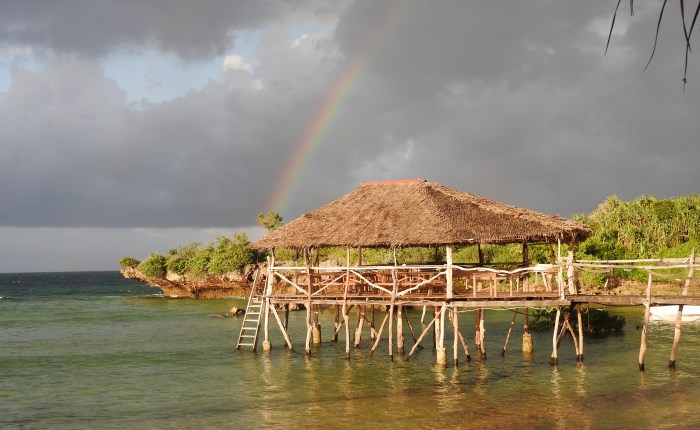
Fish Eagle Point in Tanga, Tanzania

Fish Eagle Point in Tanga, Tanzania

http://www.fisheaglepoint.com/

Wednesday June 22nd:

We had hoped to take a dhow, the traditional wooden sailboat, from Tanga to Fish Eagle Point (FEP), but the weather did not cooperate.  Simon from FEP picked us up at the hotel instead.  We drove along the very good road, built by America as an aid project, until turning offonto a dirt road.  We drove along tons of coconut palms and occasional baobab trees.  The road grew rutted and muddy.  We passed a large village with a fine American built school.  The tribe in these parts are the Digo.  Most of the homes had thatched roofs unlike the metal roofs of the mountain homes which were often constructed from repurposed vegetable oil cans.  

We traveled further to a remote area. We parked amidst some mangroves and followed Simon to our AMAZING cottage on the beach.  

CLICK PHOTOS TO SEE LARGER VERSION

Our cottage is artistically designed and open with half walls, and a soaring thatched roof.  We have a porch, main bedroom, second bedroom, large bathroom and storage room.  The cottage is on the beach and at high tide the water is within feet.

The tide was a long way out revealing the sea floor, a huge beautiful piece of white driftwood,  and an undercut tower of rock with mangroves on top that is an island at high tide.

The girls began beach combing immediately.  Reef shoes are a must as sea urchins are lurking in crevices.  Fish Eagle Point does not allow any shell collecting and as a consequence the beach is covered in the most amazing variety of shells including scores of intact sea urchins. Joe and I took the long path through the mangroves, past other cottages, to the extensive main lodge, pool and kitchen.  After getting some reef shoes and bananas. We rejoined the girls on the beach before our cottage.  They were walking with Benjamin and two german shepards.  Benjamin is the dog’s trainer and the young dogs are working on socialization with the tourists, and kids in particular.

Our lunch was served on a pier off the main lodge, built over the beach area that was dry at low tide.  

We chatted with Simon, a white man raised in Zimbabwe, South Africa and Tanzania, and his girlfriend Eva, from Latvia. The beach area off the main lodge is a crescent shape edged by undercut coral rock mangrove topped towers that become islands at high tide. As we ate, we watched the tide come in quickly filling the beach area basin.  The girls climbed down the ladder from the pier and explored the craggy rocks. Soon the girls were wading and then swimming as the tide came in.

We spent the afternoon at the main lodge.  Beach combing, swimming in the ever deeper water, and the girls enjoyed the pool.  Shortly after 5 PM, at high tide, we went out on kayaks with Eva into the mangroves.  The water in the mangroves was clear and we snorkeled.  Unfortunately the coral reef in the mangroves had a fair amount of bleaching damage.  We did see some healthy corals and two huge clams.  These clams were at least 18 inches across with a wavy lip that faced up right. Between the clam shells was a vibrant purple flesh that quivered and retracted if you swam close.

It was pretty late by the time we got back.  We cleaned up, eat dinner and went to bed.  It was hot and the breeze from the open walls was welcome.  We could hear the ocean close by all night.

Thursday June 23nd:

There is a long trail between our room and the main lodge.  There are always hermit crabs and large millipedes scuttling along the path.  At night, bats flutter by.

We hung around the lodge in the morning as the tide went out.  

Mid morning, when the tide was low, we donned our snorkel gear and awkwardly made our way through the sea urchin infested shallows to deeper water where we snorkled around individual coral “bomas”.  Unfortunately here too there was extensive coral bleaching and the reef did not look healthy.  Still we saw some nice corals and fish.  I saw more anemone than I have ever seen, but they were ominously snow white instead of the expected creamy orange color.  Again I saw some of the amazing giant clams.  After the others made their way in, I swam out to the farther reef and found it to be in the same condition.

Another family arrived in the afternoon, Mikale is Danish and had lived in Tanga for five years, and her Tanga native husband of Indian descent Darmesh, and their two young children.  The family are old friends of Simon.

After a lazy afternoon we had a fine dinner including fresh calamari.

Friday June 24th:

We were up early, before the basket with tea, instant coffee and little pieces of cake arrived on our porch.  After spending some time on our beach we headed to the lodge for breakfast.  After breakfast I want on a village tour with Aidi while Joe and the girls stayed around FEP.  

Aidi speaks no English and I only know greetings and a few words in Swahili, so we had interesting communications all morning! We walked along fields passing a few baobab trees.  Then we entered a coconut tree grove with occasional mango trees and areas of banana trees. We passed a few villagers who were delighted with my fumbling greetings in Swahili.  Aidi kept coaching me and tried to teach me too many Swahili words until my brain was overflowing. Aidi toured me around three villages and I greeted the people over and over again and was very well received. I saw a couple of their open wells with coral rag (stone) walls and cut open plastic cans tied to ropes to haul the water out. According to Simon of FEP, the water is brackish and would be deemed non potable by us, but the Digo tribe live their whole lives drinking it. The largest of the three villages seemed to be growing fast with lots of new construction including a new mosque. Many colorfully dressed women were engaged in washing clothes in in sudsy tubs, while others were grouped together on a front porch plaiting palm fronds to make long narrow runners.  When asked, the grown ups refused to have their picture taken.  The throng of kids that gathered behind me hand no such qualms. The men not engaged in construction endeavors seemed to be just hanging out.

After lunch we joined Aidia again for a hike around the rock tidal pools along the shore.  We had a late start and the tide was coming in fast. We walked up to our knees in water, under the undercut coral rage bluffs.  The wind howled making it impossible to hear each other speak, but keeping it cool as well.  We kept a brisk pace trying to keep up with Aidi as we raced against the tide.  Eventually we turned inland across a shallow submerged bay with tons of brittle sea stars, a few sea cucumbers and lots of seaweed and onto a beach.  

On the beach we found a fisherman.  We showed us the many squid he’d caught.  He also subtly relinquished the beautiful huge puka shell he’d collected against the rules of FEP. Coming up from the beach we encountered a spectacular baobab and then followed an overgrown footpath to a dirt road leading back to FEP.

Back at the lodge we met the latest guests Erna and Mark, a California couple originally from Texas.  Erna runs a nonprofit focused on rural education in Tanzania and Kenya.  For dinner we had an amazing feast on huge delicious crabs caught in the mud of the neighboring mangroves.

Saturday, June 25th:

After breakfast all the guests wade through the high tide and boarded the dhow, an ancient Arabian style of sail boat. It was very overcast, but we motored out of the bay hoping the sun would break through.  The winds this time of year blow in one direction, so the plan was to motor to a sandbar that is exposed at low tide, and sail back. We motored into the wind and the boat heaved up and down smacking into the grey waves sending water spraying over the bow where the girls were seated delighted.  After an hour we arrived at the sandbar before it was exposed and I was feeling pretty seasick despite the Dramamine.  We threw anchor and tossed in the boat or swam in the shallow water awaiting the tide to drop.  The sky was a heavy grey and and the wind was relentless and brisk. I took another Dramamine.  We’d all brought snorkel gear, but it mostly went unused in the choppy water under the dark sky.

Finally, the sandbar began to appear and I sat on the much appreciated stable ground shivering, but starting to feel better.  Flocks of terns and a lone kite or eagle circled the sandbar annoyed by our presence.  The sandbar was littered with shells and coral bits.  After a bit those of us on the sandbar returned to the dhow.  The crew pulled in the anchor, hoisted the sail, and secured ropes.  The Dramamine was working, the sea was calmer and we enjoyed the rapid sailing back to FEP.  We anchored way out because the tide was low and waded in across the seagrass.  

We all enjoyed lunch on the pier and afterwards Eva led me and the girls on a short walk through the mangroves and then retracing some of our previous days rock pool hike.  Eva showed us amazing fossilized giant clams tucked back in the caves within the craggy rocks.

The remainder of the afternoon was spent napping, reading, writing and showering.

Joe: Jogoy School: Questions about Donald Trump and how we keep our animals

June 10:  Jogoy School:  Questions about Donald Trump and how we keep our animals

After our meeting with the headmaster of the secondary school and the obligatory signing of the third guest book in the village, we moved next door to the computer lab.  Although classes had already finished for the semester, about 8 girls and boys were huddled around some old dusty desktop machines.   One group was looking at an art history dvd and the other was advising one of the students on his next move in solitairre. I’d estimate the students were around 14 – 16 years old, and they had a mix of muslim and christian names.  The headmaster asked the students if they had any questions for the visitors.  We received a lot of interesting questions from the students, but there were two topics that were the most memorable.  

One of the muslim students, Nusra, asked a lot of questions in perfect english   She was one of the younger (maybe just shorter) students in the group, but she was confident and super curious.  Over the course of the next hour, she was the student who volunteered to describe their science  experiements on electroysis, generating bio-gas, etc. in their  newly constructed, but rudimentary “laboratory.”   She asked thoughtful questions about drug and alcohol problems in the US, and described the problems with alcholism in their community.  In a country where girls are mostly relegated to work in the home, are taught to assume a subservient position to men,  and usually do not have the educational opportunities of male children, she was obviously working to defy the limitatons of her circumstance.  And so it was her first question that was easiest to answer, but I continue to reflect upon long after leaving the village:  Are you going to vote for Donald Trump or Hillary Clinton?  I answered that I would vote for Hillary Clinton.  I didn’t tell her that Donald Trump is a misogynist.  I didn’t tell her that he is campaigning to ban people of her faith from entering our country.  We recevied a generous welcome in her school and village.  I told her I was embarrassed by Donald Trump.

The next question came from “Patrick,” who inquired about the differences in the agricultural practices in the US.  I told him that nearly everone is involved in agriculture in Tanzania, but only a very small percentage of the people in the US produce food for the rest of the population.   In Tanzania, people live very close to their cows, goats, and chickens.  In the US, there is a much more pronounced separation between where most people live and where livestock is raised.  The students seemed satisfied with my answer.   Later, after we left the school and were headed back to the government office for lunch, the school headmaster looked a bit perplexed.  He wanted to follow-up on the discussion about animals in our communities.  You don’t live next to the chickens?  People don’t have chickens at their homes?  Nope, not even chickens.  

Joe: Learning Swahili, Guacamole, and Globalization

Sunday, June 12th:  Learning Swahili, Guacamole, and Globalization

Some of my favorite Swahili are those where the words is repeated:

Dalla dalla:  the colorful mini-van taxi designed for 7, but often filled with more than double that number.

Pika pika: motorcycle.  They are usually cheap models from China, and they are one of the main modes of transportation in Tanzania.  My favorite make is Kinglion with its picture of a big-maned lion sitting against a backdrop of a snow-capped mountain on the side of the fuel tank.  The picture is framed with a leopard spot motif on the remaining area of the tank.  Sometimes there are fancy strings of christmas lights strung on the bike.

Boda Boda:  motorcycle “taxis” carrying people, produce, furniture, and anything else they can balance on two wheels on the  rutted dirt roads of the country.  The received the name long ago when motorcycles first appeared in Uganda, and started taking passengers across the border border.

Pili pili:  a hot sauce similar to siracha.

Ku Ku:  chicken

Pi Pi (“pee pee”):  candy.  Ruby and Jane like this one too.  Jane also likes the fact that the english pronunciaton of “coffee” means slap in Swahili.  She keeps reminding me that I better say “kahawa” or I’ll take one to the face.  

Pole Pole:  Slowly.  Describes much of life in Tanzania.

Doo Doo: Insect

On our first lunch stop on the trek with Issa, we sat in a small clearing next to the road on his shuka blanket and watched as he unpacked the ingredients to prepare our meal.  He pulled out some avocados, lime, and tomato.  Have you ever had guacamole?, he asked.   Next he pulled out some aluminum containers, that contained chapatis, samosas, some chickpea flour fried doughnuts that resembled hush puppies.  So we had Mexican-Indian fusion cuisine in the Usambara mountains of Tanzania:  I am going to open a food truck when I get back home.

After lunch, we continued our walk along the road until we emerged at an old monastery, that had been founded by the Germans in the late 19th century.  Since it was Sunday, there place was eerily quiet as the monks were spending the day devoted to prayer.  The grounds of the monastery were planted with a vineyard and a large macadamia orchard; the brothers support the monastery with the proceeds from the sale of wine and nuts.  

Although much of the country doesn’t have electricity and and most people still gather water in buckets from running streams, there are still so much evidence of how this part of teh world has never been cut off from the rest of the world.  The Indian chapatis, the Luthern institutions present in all of the small villages of the mountains, the Chinese made youth underwear sold in the colorful Pinacolada stand at the Lushoto market, and of course, the millions of Coca-Cola signs that are everywhere.  

4 Day Trek to Mambo

click on photos to see larger image.

Day 1: June 16

The call to prayer woke us early after a poor night’s sleep and we had trouble getting back to sleep.  We picked up our laundry and began organizing for the trek. Meanwhile adorable fluffy little yellow birds, a type of weaver, chattered in the bottle brush tree outside our window.  We had a breakfast of eggs and toast in the hotel restaurant.  Then our guide Said Salim arrived to begin our trek to Mambo.

We began on foot down the congested main street of Lushoto. The ground was littered with plastic, buses, vans and motorbikes kicked up dust, and pedestrians in colorful attire bustled along.  We turned off onto a side street toward cultivated land land and trees leaving the din and garbage behind.  
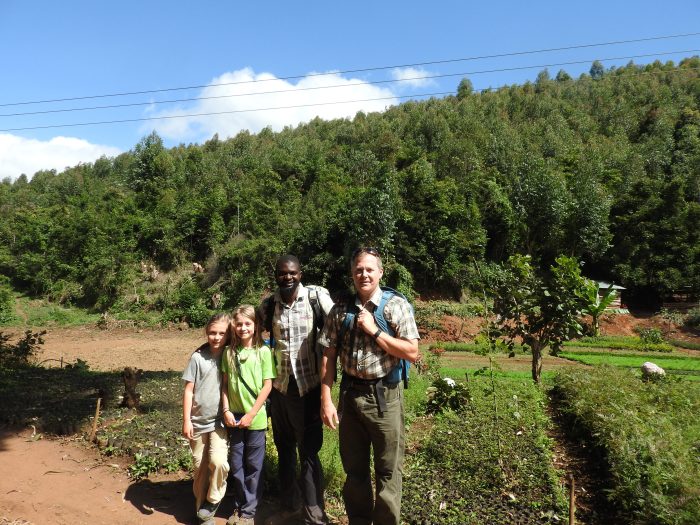
with Said Lushoto

Coming to a stand of eucalyptus trees Said explained how the Germans had taken the land from the tribal chiefs of the Usambara and cut down the forests to plant tea and coffee.  When those crops proved ill-suited and erosion became a problem, the Germans planted imported Australian Eucalyptus trees which are now prolific through the Usambara mountains.

Most of the day we followed dirt roads through pretty valleys and mountainsides planted with crops.  Unlike the previous trek, along with wattle and daub homes we saw many nice brick and concrete homes with glass windows, some with two stories. There were a few fragments of native forest and we got a good look at a black and white colobus monkey in one such area.  

Said also spotted chameleons and got a tiny young one for us to hold.  Later he gave Jane a big one which was a bit much for her to handle.

In a beautiful grassy meadow we stopped for a picnic lunch of guacamole in chapati and fruit. The last portion of the trek was through the grounds of a local university empty with the students out for summer break.

Ten miles in and footsore from a fifth day of hiking we completed the journey to Lukozi in a van.  The valley approaching Lukozi was a beautiful patchwork of gardens all along the valley floor and terraces on the hillsides and forests along the mountain ridges.  Farmers were hard at work with hoes or watering cans.

We entered the dusty town, the main road lines with vegetable stalls backed by ramshackle shops, and Said did some quick shopping.

We continued on to the home of Lucas , the District Commissioner, where Said had arranged a home stay for us.  The fine home is on a terraced hill above on the outskirts of Lukozi above a valley of crops.  Lucas, his wife Cecilia, his son Satil and the children Winnie, Martha and Alice made us feel very welcome.

Lucas gave us a tour of his late father’s home where he grew up as a boy up the hill from his new modern house. Later, Satil made a small fire in the terraced field and we had tea outside around the fire with the children.  

Soon Jane discovered there were many adorable puppies just a few weeks old.  They were all in a pile of dried cornstalks. There were two litters with a total of eight puppies. Jane spent most of the evening carrying puppies around.  She named them all: Lion, Lady, Brave, Whimpers, Patches, Howler, Precious and Flash.

We then met two American peace corp volunteers, Tommy and Erin, who are staying in the house next door.  Cecilia invited them to join for us for dinner as well.  I was able to help prepare dinner a tiny bit cutting onions in the stand alone kitchen building.  They do not use cutting boards, but cut in their hands dropping the cut pieces into a bowl.  Shortly after the dinner feast, we headed to bed.

Day 2: Friday, June 17

The damn rooster directly outside our window began crowing at 4 AM.  It was crazy loud and we never got back to sleep. Finally we got up and went out to watch the sun rise over the farm fields in the valley.  Jane was up already playing with the puppies.  Ruby rose and joined her.

After a while Ruby and I joined Cecilia and her daughters in the kitchen house to help make chapatis.  First the dough of flour, egg and oil.  Then on a low table a large circle is rolled out.  Sunflower oil is rubbed on it and then it is sliced into strips.  Each strip is rolled as if to make a cinnamon roll.  We did this until a bowl was full of the rolled dough balls.  Then with lots of dry flour each ball is rolled into a dinner plate sized disk.  The raw chapatis are cooked in pairs over the charcoal in an oiled metal tin.  More oil is lavishly coated on the chapatis as they cook.

After our breakfast of chapati, omelet and fruit we set out to resume our Usambara bootcamp.  We said many goodbyes to our hosts, shouldered our packs and headed steeply up.  We passed a dusty barren spot with piles of rocks where people “mine” the stone they need.  We past an area with sisal agaves and Said demonstrated that fibers could be harvested to make rope.  There was once a booming sisal industry in Tanzania and there still are sisal plantations. We continued climbing for an hour alongside a pretty cultivated valley.  

Finally cresting the ridge, we began a steep descent past homes and small villages.

In one village a torrent of young children began running alongside us as usual. This time however, they were more bold and some began to touch Ruby and Jane’s hair.  Then they started holding hands with Ruby and Jane.  So a throng of adorable but filthy children, some with babes on their backs, were all around us singing and chattering.  We became a parade with more kids joining all the time, kicking up dust from one end of the village to the other.  Said had then singing the Tanzanian anthem and the instructed them to say goodbye and leave once we reached the edge of the village.

After another hour we completed our 9 mile walk and reached our destination the Rangwi Convent.  The young nuns showed us to our guest house.  Said made a batch of guacamole and chapati for a late lunch and we each had a bucket shower.  We had a few hours of welcome downtime before dinner.

We headed to the convent restaurant in an old German colonial building for tea before dinner.  At dinner a family from Denmark arrived.  They are living in Zanzibar for one year.  The two groups ate together a meal of vegetable soup, rice, cooked carrots, cooked cabbage, fried potatoes, beef and bananas.

Day 3: Saturday, June 18

Ruby awoke nauseous and not feeling well. After some reading aloud in bed and breakfast she was sufficiently recovered to take on summitting Mount Mzogoti.  We began our walk with a visit to the weekly Rangwi market which was just getting started to buy fruit and bread for snacks. The five mile round trip to the summit started off gently.  We eventually left the village and homes and were hiking up bare rock with wattle tree bushes.  The last section was very steep through dense brush.  The we emerged onto the clearing at the top with a 360 degree view of Usambara mountains and valleys.  Most was fully cultivated, villages and homes dotted everywhere.  One mountain was a protected forest and blanketed with trees.  Clouds poured over a far ridge descending into a valley.  When these clouds drifted away we could see a far plain beyond which Said said was Kenya. We enjoyed our snacks on the summit including a pomegranate a nun had helped Jane pick from the garden upon our departure.

The way down was very steep and we descended rapidly. Along the way we saw scores of huge bats hanging together in a tree.  Their bellies were blondish and their faces looked like a kangaroo. The bats were chittering and vibrating.

Once back in the village of Rangwi we found the colorful market in full swing.  We bought some Tangawizi (spicy ginger ale), ginger, a coconut, some fruit, and a skirt made of kanga fabric for me.  The women in the market wore amazingly colorful outfits.  There were many stalls of clothing and vegetables, as well as, nice sandals made of tires, sisal ropes, and medicinal stalls including a variety of powders and of all things donkey poop!

The nuns served a generous lunch upon our return and made a hot tea from the ginger to help Ruby’s tummy that we all enjoyed. Afterwards each retired to their own entertainment: writing, reading or drawing, later the girls were playing and eating sugar cane.  At one point we were visited by some nuns.  More and more came to crowd around our porch until there were 13.  They were mostly interested in Ruby and Jane.


Later our previous guide Issa came by with 11 German medical students he is leading on the same trek. After the long lazy afternoon we headed to the restaurant for dinner.  The moon was full and the nuns were singing and chanting outside near a shrine.  Their beautiful hymns were punctuated by ululations. We had the same dinner again: soup, rice, potatoes, carrots and cabbage and then went to bed.

Day 4: Sunday, June 19

I woke to church bells at 6 AM.  Joe and I sat on the porch listening to the roosters crowing and the black and white crows cawing as they zoomed around.  Then the nuns began chanting, singing and ululating beautifully in the church below our guest house.

After a breakfast of omelette and bread we said goodbye to the nuns and embarked on the last day of our trekking.  We followed a dirt road gently uphill past homes and fields. Joe and Said ahead in conversation about economics and politics, me back with the girls who wove cordage from sisal fibers while walking. Eventually we entered a patch of forest. We took a rest and Said cracked the coconut we had bought in the market we drank the coconut water and eat the fresh coconut meat.  Nearby some women and children were also resting from carrying big bundles of harvested bean plants wrapped in kangas.  As we were leaving the placed these bundles upon their heads and headed off as well.

In the forest there were many butterflies including beautiful blue and teal ones.  After the leaving the forest we entered a planted forest of pine trees.  Sadly there were huge stumps of the native Octea trees beneath the pines. We exited the pine forest near a sawmill with mounds of sawdust.  Further there was a hillside purely of beans with just a few trees on top.  The area had just been harvested of pine trees; there were pine stumps and newly planted pine seedlings among the beans.  The final approach to Mambo was very steep.

Said spotted a chameleon and demonstrated how terrified the locals are of the color changing lizard.  They believe that a chameleon will get caught in your hair and can only be removed by our uncle or aunt.  You may have to wait for them to come all the way from Dar Es Salam!  He teased the locals by the harmlessness of chameleon on his head.
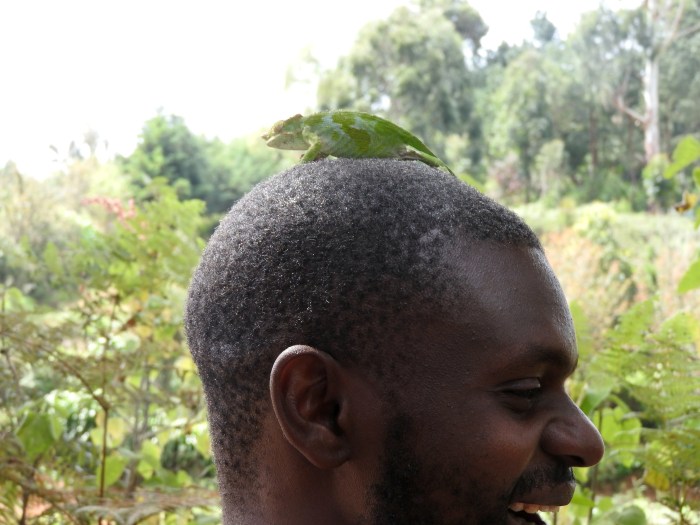
said and chameleon

Then we entered the village of Shuga. We passed a ramshackle “art center” where we met Makanyage, an artist, and his students.  Makanyage’s paintings were all laid out and we picked two favorites and bought them.

Next we came across an elderly man with a guitar selling roasted peanuts.

guitarist

We complete our 11 mile mile day with a very steep ascent to the Mambo Viewpoint Lodge.

We were very surprised to see a bunch of Tanzanian children on unicycles and juggling in front of the hotel!  The European owners of Mambo Viewpoint Lodge sponsor many programs in the area including the circus training.

Our cottage is on the edge of a cliff with an amazing view.   It has a round shape and a peaked thatched roof.  There are paintings by Makanyage throughout the hotel.  We spent the afternoon at the lodge.  

The girls doing artwork, Joe doing laundry in a bucket and me writing.  
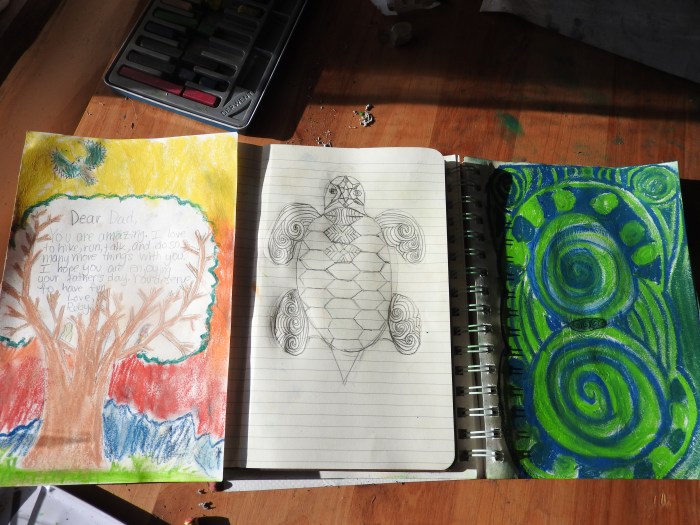
girls artwork

At 6:30 dinner was served and all the guests, all European except for us, sat together for the meal. As we went to sleep we heard the drumming and singing celebrating Ramadan.

Monday, June 20th

We were awoken by the loud and tuneless “singing” of the call to prayer at 5 AM.  It was so loud and the voice sounded angry and the singing parts were totally off key.  It went on and on and we never got back to sleep.

The sunrise view of swirling clouds was nice.  We had a clear view to the dry valley floor far below.  Many clouds were below us creating a view similar to being in an airplane.

We had hoped to get internet here and update our blog, catch up on the news, and read email.  The internet service is down, but still we get whatsapp and Facebook.  Nothing else.  Apparently Facebook has built an internet infrastructure here and offers it for free, and Facebook owns whatsapp. So even though Mambo Viewpoint’s paid internet is down we can still access Facebook and whatsapp.

We spent the entire day at the lodge putzing around.  We wrote, read, reviewed our photos, bird watched and made artwork.  The morning was socked in with clouds, when the clouds cleared in the afternoon we enjoyed terrific views.  We are so high up looking out on distant mountain ranges, and plains with clouds drifting and sunbeams shining in an ever changing display.  In the early afternoon a rainbow arched above the village of Mambo and surrounding cultivated hills.
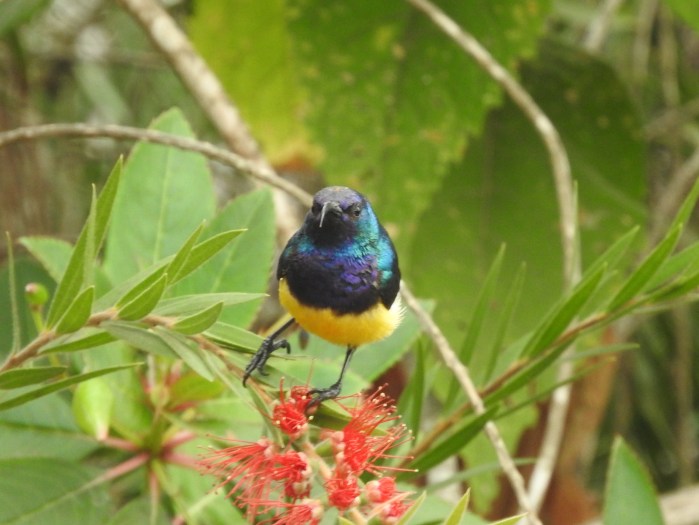
variable sunbird

The lodge includes a playground with a very nice and huge trampoline and a ramshackle slide and swing. All day Tanzanian kids were jumping on the trampoline and Ruby and Jane joined them much of the time.  Joe spent some time after lunch with Bart, a young volunteer from the Netherlands, learning about the large rainwater cistern he has constructed at the lodge. In the late afternoon we enjoyed a very entertaining circus act by a bunch or Tanzanian kids where are taking a circus class at the lodge.  They performed fairly amazing feats accompanied by three drummers. The many tricks included unicycles, hula hoops, jump ropes, juggling and more.


4 Day Trek to the Mazumbai Forest

Photos will follow.  We have very limited WiFi for uploading!

Day 1: June 12

Today we began a four day trek to Mazumbai Forest Reserve.  We woke early and left Irente Farm after breakfast.  Abdullah, a driver, took us to the office of ‘Friends of Usambara’ in the town of Lushoto where we met our guide Issa and discussed our trek.  We left the majority of our stuff with them, taking just two backpacks carried by Joe and myself.

Before launching on our trek, we spent half an hour exploring the colorful Sunday Lushoto market.  There were piles of vegetables, beans and rice sold by vibrant kanga draped women, and a steady stream of shoppers.  Many Muslim men wore a flat topped circular cap and a couple of women were in the full haike with only their eyes showing.  We bought a couple of coconuts and a papaya. Beyond the vegetables were stalls of dried fish, colorful kangas and dress, and then piles of western clothes. Turning a corner, there was an indoor portion of the market mostly full of dried fish including smoked tuna collars.  Beyond that were stalls with mattresses, luggage, and Jane saw a whole stall of Vasoline.

Next we were driven to the a trail outside the town of Soni.  There we began our 5+ hour (10+ mile) hike.  We followed a single track path steeply up through mountainside gardens of banana, coffee and corn punctuated by impressively tall and massive trees.  Ahead was an massive rock faced mountain named ‘growing rock’. Along the way we spotted two chameleons.  Joe and I were streaming in sweat by the time we finally crested the ridge and the path leveled out.  The trek continued on a dirt road passing a village with views to cultivated steep hillsides and occasional buildings.  Everyone we passed was friendly.  

We found a good picnic spot and enjoyed Issa’s guacamole and chapati, samosas and a chickpea fried dough {like a hush puppy) with oranges and bananas. After lunch, we passed a German established monastery compound and a herd of cows before emerging onto a wider dirt road with light traffic.  The last hour we walked along the road passed by occasional motorbikes (piki piki) and vans and passing many villagers, homes and goats.

Footsore and tired we finally turned off the road and took a narrow path down, across a stream, and up to the home where we stayed the night.  Our host was Vincent.  The home was three wattle and daub buildings, two small cow stables, and a two room, three bed homestay accommodation for tourists built in the back underneath a grove of amazing avocado trees.  Vincent had set up a table under the avocado trees and served us hot tea. At random moments avocados would drop with a thud and roll down the slope.

After relaxing a bit, and revived from the tea, we explored the paths around the home.  On a dirt road we found many young children who were very interested in us, especially Ruby and Jane.  After completing our explorations we sat with Issa on some logs by the road and a crowd of children gathered round slowly approaching closer and closer.  The older kids had little babes on their hips. The girls wore there hair very short and were draped in colorful kangas.  Some little boys were more interested their soccer game with a ball made of plastic bags. Another boy chased his rolling tire up and down the path.  When an adult came and greeted us and we successfully responded in Swahili, the kids erupted in laughter and drew in very close sitting on the adjacent logs.  Several girls began to raise their eyebrows up and down at us in a comical way.  Finally we asked to take a picture and they erupted again coming even closer.  Then two woman swooped in from the nearby church and said something and the kids all hustled away after them.

Before a simple dinner in the dark under the avocado trees, we enjoyed a small fire with Issa and Vincent.

Our room is very basic, although of brick and plaster construction unlike our host’s home of wattle and daub.  There is a bathroom with no running water or light.  We use our head lamps and flush by pouring in water from a bucket.

Day 2: June 13

Our 7 hour (13+ mile) trek began after breakfast under the avocado trees.  Vincent our homestay host joined the hike to help Issa carry all our provisions. Immediately we had a steep ascent up a cultivated slope.  There are no switchbacks; instead the footpaths go mercilessly straight up, or perilously straight down.  After a while we left the patchwork cultivated slopes entering a German owned tea plantation. Many hillsides were covered in neat rows of ancient tea plants.  We saw a couple workers picking tea.  Other laborers aggressively trimmed the woody plants with sickle hand tools leaving the plants dead looking, but apparently they will sprout the desired new leaves to be harvested.

Two hours into our hike we reached the edge of the forest with towering trees and cool shade. Soon we left the wider trail and followed a narrow footpath steeply up into the ever darker, cooler, and damper forest.  Tall fern trees, combined with the enormity of the giant trees making the canopy above, gave the forest a prehistoric look.  At first the underbrush was low beneath towering trees covered with mossy vines and epiphytes of all sorts.  The trail climbed relentlessly, the air grew cooler and damper, and the under brush grew taller until it was as if we were in a wet green tunnel with no visibility at all.  Everything was dripping and the ground was like a slippery compost pile. Looking straight up we could see the canopy far above and glimpses of the sky beyond.  Despite the cool air and the wet cold leaves brushing against us, Joe and I were streaming sweat and literally steaming into the air as we labored up the mountain.  I took an embarrassing but harmless spill after slipping on a wet root and needed Joe’s assistance to regain my feet.

Finally when the trail leveled off and widened just a bit we asked Issa and Vincent to stop for our lunch break.  While Joe and I were kept warm by our labor, Ruby who had no backpack and is quite fit, had become freezing in the cold and wetness.  Everyone became cold when we stopped moving, our fingers numb.  We scrambled for coats and hats as Issa prepared guacamole despite being cold and wet himself.  After eating guacamole and sandwich bread, roasted sweet potatoes, bananas, and oranges we felt revived.

The trail now dropped precipitously through the forest. We descended rapidly.  Then Vincent spotted a blue monkey.  The solitary dark monkey looked like a shadow in a tree, but when it moved we saw it fairly well.  A bit later Vincent spotted a group of black and white colobus monkeys in a nearby tree. When I foolishly called to Ruby to be sure she saw, they scampered and took incredible bounds out of the tree to hide elsewhere.

Our path left the deep amazing forest to skirt along its edge and through steep cultivated mountainside at high elevation.  We saw more locals on the very narrow footpath, some carrying wood or grass bundles on their heads, many carrying hoes, sickles or large brush knives.  The day was clear and beautiful with a cool breeze.  The view was amazing of ridge after ridge of Usambara mountains mostly cultivated with forests on top and dotted with homes or small villages.

When Issa finally pointed out the distant red roof of our guest house we were much relieved.  The trek’s rigor had exceeded our expectations, but the experience was totally worth it.  We passed through the small village of Mazumbai before turning into the gate of the Mazumbai Guest House.  By this time even the steep drive up to the rooms was a struggle and I was eager to drop my pack and get off my feet.

The staff greeted us and we found our two huge rooms each with two beds.  After a bit we explored the place and found a living room with a fire going and a lovely young American  woman from Chicago, Stephanie, who was staying for months at the guest house to study the local sunbirds for her dissertation. Stephanie has two assistants: Happy, a Maasai Tanzanian woman, and David, a man from Colombia.  They are one month into a 7 month stay at the Mazumbai Guest House to do research.  They use nets to catch and tag the sunbirds.

We demolished a dinner of ugali, rice, beans, and vegetables with Issa and Vincent and went to bed shortly thereafter.

Day 3: June 14

Refreshed after a good night’s sleep in the Mazumbai Guest House, we had a relaxed morning. Jane read her book on the sunny lawn and Ruby observed the sunbirds while drinking her chai. Then Issa joined us for a breakfast of crepes and omelet.

After breakfast we went for a walk in the forest.  We walked along a dirt road with occasional motorbikes and locals on foot. Enormous trees towered over the road, their canopies a sillouette high above us.  We passed tea fields occasionally.  Issa spotted a chameleon basking in the sun.  As we progressed deeper into the forest it grew darker and cooler in the dense shade.  Issa spotted a group of black and white colobus monkeys high in a giant tree.  Their fur is long and the bright white stripes along either side of their faces and shoulders reminded me of a skunk.  They have long black tails with a white tuft at the end.  They are adorable!  We spent some time watching them with our binoculars.

We followed the road a it further and the took a narrow footpath steeply down.  Many of the huge trees had buttresses of roots sloping down diagonally like the folds of a full skirt.  We came to a tree with the most amazing buttress roots of all.  A handful of buttress roots formed walls 8’-10’ high, travelling out from the wide, tall, straight trunk.  These buttresses went along as much as 30 feet, the longest one ending by spiraling in on itself.  It was an incredible spot and we stayed a bit with the girls climbing all over these incredible roots.

We climbed the steep ascent back to the road, our legs recalling the previous day’s walk.  About halfway back we encountered four more black and white colobus monkeys, this time closer in a tree over the road.  They were unphased as a motorbike with music playing passed by.  We watched them sitting around and grooming each other for a while.  Moving on, Issa spotted a few more chameleons including a rare one the remainder of the walk.

After a lunch of spaghetti and cooked vegetables we each did our own thing. I am writing the blog sitting under an amazing big bottle brush tree at the top of the guest house garden as sunbirds flit about drinking nectar from the blossoms, and the garden’s irrigation stream babbles by.  Jane is likely reading her book in a sunny spot or under the covers of her bed. Ruby and Joe are be perched in the deep windowsill of our room observing the sunbirds as they visit the bush with pink blooms outside the window. At first we thought they were hummingbirds, but apparently there are no humming birds in Africa.  There are many varieties of little metallically colorful sunbirds with long narrow beaks that curve downward at the tip visiting blooms of all sorts.  The ones we are seeing are double collared Usambara sunbirds.

In the late afternoon we have another forest walk with Issa in a different direction.  The walk began following the shallow irrigation canal that feeds the garden irrigation and was built, along with the guest house, by the Germans during the period of German colonization. Then we turned steeply uphill on a narrow path. Again we found the black and white colobus monkeys and huge trees with giant canopies far above and buttressed roots.  There was a steep valley with a beautiful view across the the forest.  Some giant trees filled the valley covered in some epiphyte that hung down like a giant green beaded curtain.

After the walk I had a much needed “bath” with a bucket of warm clear but brownish water.  Now I am writing by the fireplace as the girls run wild outside and Joe updates his journal.

My Chromebook is still going, but two of three cameras and Jane’s Kindle have dead batteries.  We left half our stuff in Lushoto to travel light on the 4 day trek and thought our devices would make it.  Next time we’ll either bring the charging stuff or extra camera batteries.  We also miss the third and fourth pair of binoculars and the colored pencils and paper. Meanwhile raincoats and pairs of the girls shorts have gone unused.

Day 4: June 16

The sound of the sunbird scientist’s early departure to set their nets woke Joe and me early.  Joe spent the early morning stretching and enjoying the garden.  I updated the blog by the fireplace.  Eventually everyone was up, we had breakfast, packed up and said our goodbyes to the guest house staff.

We started out on the road to Bumbuli and soon ran into Happy.  She led us to where Stephanie and David were working with the birds caught that morning.  Stephanie had an Olive Sunbird in hand and weighed and measured it before setting it free.  We said our goodbyes and continued down the dirt road, out of the forest and into cultivated lands.  We left the road to follow footpaths and after 8 r 9 miles we reached the village of Bumbuli.

We had a lunch of whole fish with rice and vegetables in a church.  The old building with walls more than two feet thick was from the German colonial era.  After lunch we had a van ride back to Lushoto.

We stopped by the office of Friends of Usambara to pick up our bags.  We saw the nursery of trees they are producing to share with the community and learned about the Maasai school they helped to build for the Mombo, the community at the foot of the mountains.

We got our rooms at the Tumaini hotel.  We arranged to have laundry done and had dinner in the restaurant including decent pizza.  The showers were a real disappointment with one room having only freezing water and the other only water too hot to touch!  Using buckets we were able to get cleaned up. A black beetle the size of an egg came up from the drain in the girls’ room, luckily after we were done bathing! We fell asleep to the sound of multiple mosques’ call to prayer.  The sounds of the different chanting layer together to make a most exotic sound.


June 11th at Irente Farm

Photos will follow.  We have very limited WiFi for uploading!

We had a down day at Irente Farm today.  We went on a couple short walks including one with Richie, Ute’s partner, his dog and Nina, a German volunteer at an orphanage in the south of Tanzania. We walked in forests and past gardens on the steep mountain side. The Irente Farm land has much natural forest, and the neighboring land was planted with pine trees, loquat, coffee, peas, beans and potatoes in small plots of random shapes.
In the afternoon, a young man was giving all the female Irente Farm staff pedicures.  I got myself a manicure for just $1.

River: Visit to Jogoy on June 10th

Today we met our guide who would take us to the village Jogoy. Unfortunately, his car was a wreck and we were all crammed in the back seat. At the village we met the Chairman who said we could each plant a tree. Mom and Dad planted theirs at the Chairman’s house. Jane planted hers at the primary (elementary) school. Jane wanted a picture with her tree and a bunch of school kids crowded in. After that, we met all the teachers for the primary school.