click on photos to see larger image.
Day 1: June 16
The call to prayer woke us early after a poor night’s sleep and we had trouble getting back to sleep. We picked up our laundry and began organizing for the trek. Meanwhile adorable fluffy little yellow birds, a type of weaver, chattered in the bottle brush tree outside our window. We had a breakfast of eggs and toast in the hotel restaurant. Then our guide Said Salim arrived to begin our trek to Mambo.
We began on foot down the congested main street of Lushoto. The ground was littered with plastic, buses, vans and motorbikes kicked up dust, and pedestrians in colorful attire bustled along. We turned off onto a side street toward cultivated land land and trees leaving the din and garbage behind.
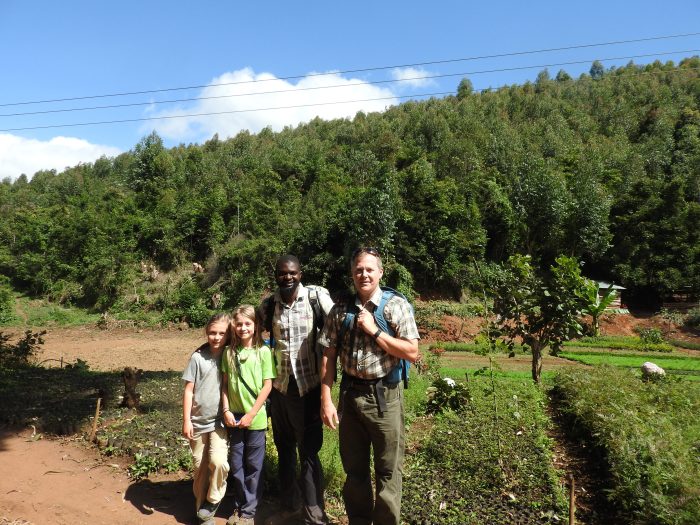
Coming to a stand of eucalyptus trees Said explained how the Germans had taken the land from the tribal chiefs of the Usambara and cut down the forests to plant tea and coffee. When those crops proved ill-suited and erosion became a problem, the Germans planted imported Australian Eucalyptus trees which are now prolific through the Usambara mountains.
Most of the day we followed dirt roads through pretty valleys and mountainsides planted with crops. Unlike the previous trek, along with wattle and daub homes we saw many nice brick and concrete homes with glass windows, some with two stories. There were a few fragments of native forest and we got a good look at a black and white colobus monkey in one such area.


Said also spotted chameleons and got a tiny young one for us to hold. Later he gave Jane a big one which was a bit much for her to handle.


In a beautiful grassy meadow we stopped for a picnic lunch of guacamole in chapati and fruit. The last portion of the trek was through the grounds of a local university empty with the students out for summer break.
Ten miles in and footsore from a fifth day of hiking we completed the journey to Lukozi in a van. The valley approaching Lukozi was a beautiful patchwork of gardens all along the valley floor and terraces on the hillsides and forests along the mountain ridges. Farmers were hard at work with hoes or watering cans.


We entered the dusty town, the main road lines with vegetable stalls backed by ramshackle shops, and Said did some quick shopping.
We continued on to the home of Lucas , the District Commissioner, where Said had arranged a home stay for us. The fine home is on a terraced hill above on the outskirts of Lukozi above a valley of crops. Lucas, his wife Cecilia, his son Satil and the children Winnie, Martha and Alice made us feel very welcome.


Lucas gave us a tour of his late father’s home where he grew up as a boy up the hill from his new modern house. Later, Satil made a small fire in the terraced field and we had tea outside around the fire with the children.
Soon Jane discovered there were many adorable puppies just a few weeks old. They were all in a pile of dried cornstalks. There were two litters with a total of eight puppies. Jane spent most of the evening carrying puppies around. She named them all: Lion, Lady, Brave, Whimpers, Patches, Howler, Precious and Flash.


We then met two American peace corp volunteers, Tommy and Erin, who are staying in the house next door. Cecilia invited them to join for us for dinner as well. I was able to help prepare dinner a tiny bit cutting onions in the stand alone kitchen building. They do not use cutting boards, but cut in their hands dropping the cut pieces into a bowl. Shortly after the dinner feast, we headed to bed.
Day 2: Friday, June 17
The damn rooster directly outside our window began crowing at 4 AM. It was crazy loud and we never got back to sleep. Finally we got up and went out to watch the sun rise over the farm fields in the valley. Jane was up already playing with the puppies. Ruby rose and joined her.
After a while Ruby and I joined Cecilia and her daughters in the kitchen house to help make chapatis. First the dough of flour, egg and oil. Then on a low table a large circle is rolled out. Sunflower oil is rubbed on it and then it is sliced into strips. Each strip is rolled as if to make a cinnamon roll. We did this until a bowl was full of the rolled dough balls. Then with lots of dry flour each ball is rolled into a dinner plate sized disk. The raw chapatis are cooked in pairs over the charcoal in an oiled metal tin. More oil is lavishly coated on the chapatis as they cook.


After our breakfast of chapati, omelet and fruit we set out to resume our Usambara bootcamp. We said many goodbyes to our hosts, shouldered our packs and headed steeply up. We passed a dusty barren spot with piles of rocks where people “mine” the stone they need. We past an area with sisal agaves and Said demonstrated that fibers could be harvested to make rope. There was once a booming sisal industry in Tanzania and there still are sisal plantations. We continued climbing for an hour alongside a pretty cultivated valley.
Finally cresting the ridge, we began a steep descent past homes and small villages.


In one village a torrent of young children began running alongside us as usual. This time however, they were more bold and some began to touch Ruby and Jane’s hair. Then they started holding hands with Ruby and Jane. So a throng of adorable but filthy children, some with babes on their backs, were all around us singing and chattering. We became a parade with more kids joining all the time, kicking up dust from one end of the village to the other. Said had then singing the Tanzanian anthem and the instructed them to say goodbye and leave once we reached the edge of the village.


After another hour we completed our 9 mile walk and reached our destination the Rangwi Convent. The young nuns showed us to our guest house. Said made a batch of guacamole and chapati for a late lunch and we each had a bucket shower. We had a few hours of welcome downtime before dinner.


We headed to the convent restaurant in an old German colonial building for tea before dinner. At dinner a family from Denmark arrived. They are living in Zanzibar for one year. The two groups ate together a meal of vegetable soup, rice, cooked carrots, cooked cabbage, fried potatoes, beef and bananas.
Day 3: Saturday, June 18
Ruby awoke nauseous and not feeling well. After some reading aloud in bed and breakfast she was sufficiently recovered to take on summitting Mount Mzogoti. We began our walk with a visit to the weekly Rangwi market which was just getting started to buy fruit and bread for snacks. The five mile round trip to the summit started off gently. We eventually left the village and homes and were hiking up bare rock with wattle tree bushes. The last section was very steep through dense brush. The we emerged onto the clearing at the top with a 360 degree view of Usambara mountains and valleys. Most was fully cultivated, villages and homes dotted everywhere. One mountain was a protected forest and blanketed with trees. Clouds poured over a far ridge descending into a valley. When these clouds drifted away we could see a far plain beyond which Said said was Kenya. We enjoyed our snacks on the summit including a pomegranate a nun had helped Jane pick from the garden upon our departure.


The way down was very steep and we descended rapidly. Along the way we saw scores of huge bats hanging together in a tree. Their bellies were blondish and their faces looked like a kangaroo. The bats were chittering and vibrating.
Once back in the village of Rangwi we found the colorful market in full swing. We bought some Tangawizi (spicy ginger ale), ginger, a coconut, some fruit, and a skirt made of kanga fabric for me. The women in the market wore amazingly colorful outfits. There were many stalls of clothing and vegetables, as well as, nice sandals made of tires, sisal ropes, and medicinal stalls including a variety of powders and of all things donkey poop!


The nuns served a generous lunch upon our return and made a hot tea from the ginger to help Ruby’s tummy that we all enjoyed. Afterwards each retired to their own entertainment: writing, reading or drawing, later the girls were playing and eating sugar cane. At one point we were visited by some nuns. More and more came to crowd around our porch until there were 13. They were mostly interested in Ruby and Jane.


Later our previous guide Issa came by with 11 German medical students he is leading on the same trek. After the long lazy afternoon we headed to the restaurant for dinner. The moon was full and the nuns were singing and chanting outside near a shrine. Their beautiful hymns were punctuated by ululations. We had the same dinner again: soup, rice, potatoes, carrots and cabbage and then went to bed.
Day 4: Sunday, June 19
I woke to church bells at 6 AM. Joe and I sat on the porch listening to the roosters crowing and the black and white crows cawing as they zoomed around. Then the nuns began chanting, singing and ululating beautifully in the church below our guest house.
After a breakfast of omelette and bread we said goodbye to the nuns and embarked on the last day of our trekking. We followed a dirt road gently uphill past homes and fields. Joe and Said ahead in conversation about economics and politics, me back with the girls who wove cordage from sisal fibers while walking. Eventually we entered a patch of forest. We took a rest and Said cracked the coconut we had bought in the market we drank the coconut water and eat the fresh coconut meat. Nearby some women and children were also resting from carrying big bundles of harvested bean plants wrapped in kangas. As we were leaving the placed these bundles upon their heads and headed off as well.
In the forest there were many butterflies including beautiful blue and teal ones. After the leaving the forest we entered a planted forest of pine trees. Sadly there were huge stumps of the native Octea trees beneath the pines. We exited the pine forest near a sawmill with mounds of sawdust. Further there was a hillside purely of beans with just a few trees on top. The area had just been harvested of pine trees; there were pine stumps and newly planted pine seedlings among the beans. The final approach to Mambo was very steep.


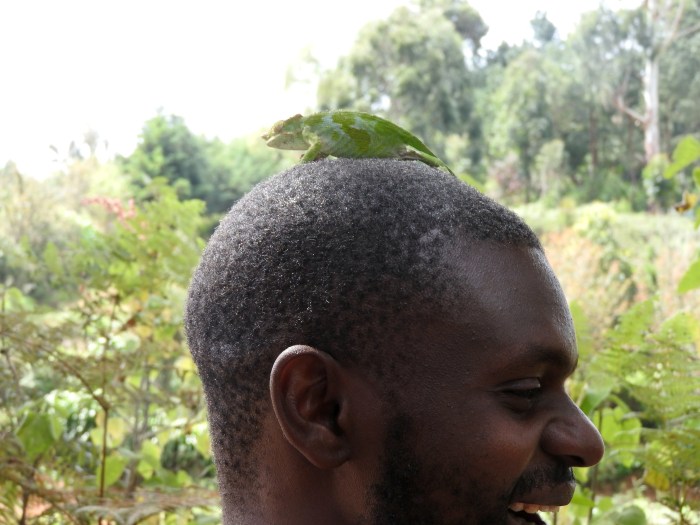
Said spotted a chameleon and demonstrated how terrified the locals are of the color changing lizard. They believe that a chameleon will get caught in your hair and can only be removed by our uncle or aunt. You may have to wait for them to come all the way from Dar Es Salam! He teased the locals by the harmlessness of chameleon on his head.
Then we entered the village of Shuga. We passed a ramshackle “art center” where we met Makanyage, an artist, and his students. Makanyage’s paintings were all laid out and we picked two favorites and bought them.


Next we came across an elderly man with a guitar selling roasted peanuts.

We complete our 11 mile mile day with a very steep ascent to the Mambo Viewpoint Lodge.
We were very surprised to see a bunch of Tanzanian children on unicycles and juggling in front of the hotel! The European owners of Mambo Viewpoint Lodge sponsor many programs in the area including the circus training.
Our cottage is on the edge of a cliff with an amazing view. It has a round shape and a peaked thatched roof. There are paintings by Makanyage throughout the hotel. We spent the afternoon at the lodge.


The girls doing artwork, Joe doing laundry in a bucket and me writing.
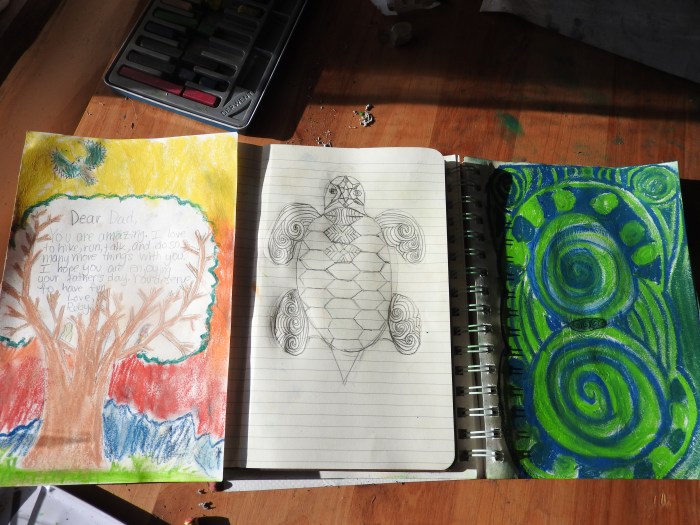
At 6:30 dinner was served and all the guests, all European except for us, sat together for the meal. As we went to sleep we heard the drumming and singing celebrating Ramadan.
Monday, June 20th
We were awoken by the loud and tuneless “singing” of the call to prayer at 5 AM. It was so loud and the voice sounded angry and the singing parts were totally off key. It went on and on and we never got back to sleep.
The sunrise view of swirling clouds was nice. We had a clear view to the dry valley floor far below. Many clouds were below us creating a view similar to being in an airplane.
We had hoped to get internet here and update our blog, catch up on the news, and read email. The internet service is down, but still we get whatsapp and Facebook. Nothing else. Apparently Facebook has built an internet infrastructure here and offers it for free, and Facebook owns whatsapp. So even though Mambo Viewpoint’s paid internet is down we can still access Facebook and whatsapp.
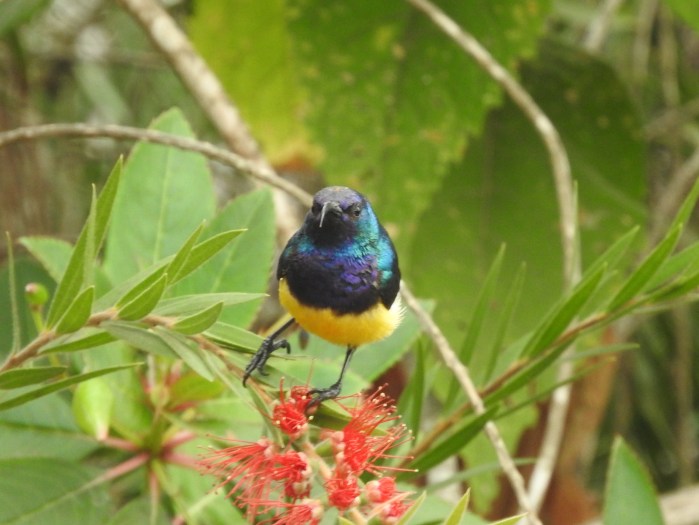
We spent the entire day at the lodge putzing around. We wrote, read, reviewed our photos, bird watched and made artwork. The morning was socked in with clouds, when the clouds cleared in the afternoon we enjoyed terrific views. We are so high up looking out on distant mountain ranges, and plains with clouds drifting and sunbeams shining in an ever changing display. In the early afternoon a rainbow arched above the village of Mambo and surrounding cultivated hills.
The lodge includes a playground with a very nice and huge trampoline and a ramshackle slide and swing. All day Tanzanian kids were jumping on the trampoline and Ruby and Jane joined them much of the time. Joe spent some time after lunch with Bart, a young volunteer from the Netherlands, learning about the large rainwater cistern he has constructed at the lodge. In the late afternoon we enjoyed a very entertaining circus act by a bunch or Tanzanian kids where are taking a circus class at the lodge. They performed fairly amazing feats accompanied by three drummers. The many tricks included unicycles, hula hoops, jump ropes, juggling and more.


 Family Adventures
Got some questions for you 🙂
1) is there a “rainy season” — is it now?
2) how’s the humidity during the hikes?
3) how are you paying for your purchases from markets etc? US currency? How are you dealing with the growing pile of acquisitions?
4) Those cottages are wicked-cool looking! What’s the floor made of?
5) explanation for the wet-butt pic?
6) Ruby & Jane look like they’re really enjoying every day. What time of night are you typically falling asleep? Everybody getting enough sleep? Mosquito nets omnipresent?
7) The Tanzanians in almost all the pics look pleased to see you — any surliness or resentment? Hope not…
Love you all — John & Tess
LikeLike
1) is there a “rainy season” — is it now?
Yes, June is the transition month after the “long rains”. July and August are the dry season.
2) how’s the humidity during the hikes?
Not too bed, but we got very sweaty all the same.
3) how are you paying for your purchases from markets etc? US currency? How are you dealing with the growing pile of acquisitions?
For accomodations, especially resorts and trekking guides we paid deposits via bank transfers months ago. We can pay European owned lodges in dollars. Oterwise we are paying in tsh (Tanzanian Shillings 1$ = 2178 tsh). We need to hoard sall bills for dukas (little shops) and the market.
4) Those cottages are wicked-cool looking! What’s the floor made of?
stained concrete. Probably the foundation slab itself.
5) explanation for the wet-butt pic?
Joe gets very sweaty hiking uphill!
6) Ruby & Jane look like they’re really enjoying every day. What time of night are you typically falling asleep? Everybody getting enough sleep? Mosquito nets omnipresent?
We are probably not getting enough sleep. The girls go to bed around 9 PM and Joe and I around 10 PM or 10:30 PM. We are usually up between 6 AM and 7 PM. All but Jane suffered from jet lag the first week. Lots of mosquito nets, although we saw few in the Usambara mountains. We are getting our first bits at Fish Eagle Point on the coast.
7) The Tanzanians in almost all the pics look pleased to see you — any surliness or resentment? Hope not…
The Tanzanians are incredibly welcoming 90% “Karibu” meaning welcome. Some small children have run from us in terror. We hear the calls of “Mzungu” menaing white people as we approach.
Keep the questions coming!
LikeLike